
With growing interest in lightweight building materials, low-density WPC doors have become a hot topic among homeowners, builders, and contractors. Many are curious to know if these lighter doors offer the right balance of strength, moisture resistance, and cost-efficiency for modern interiors.
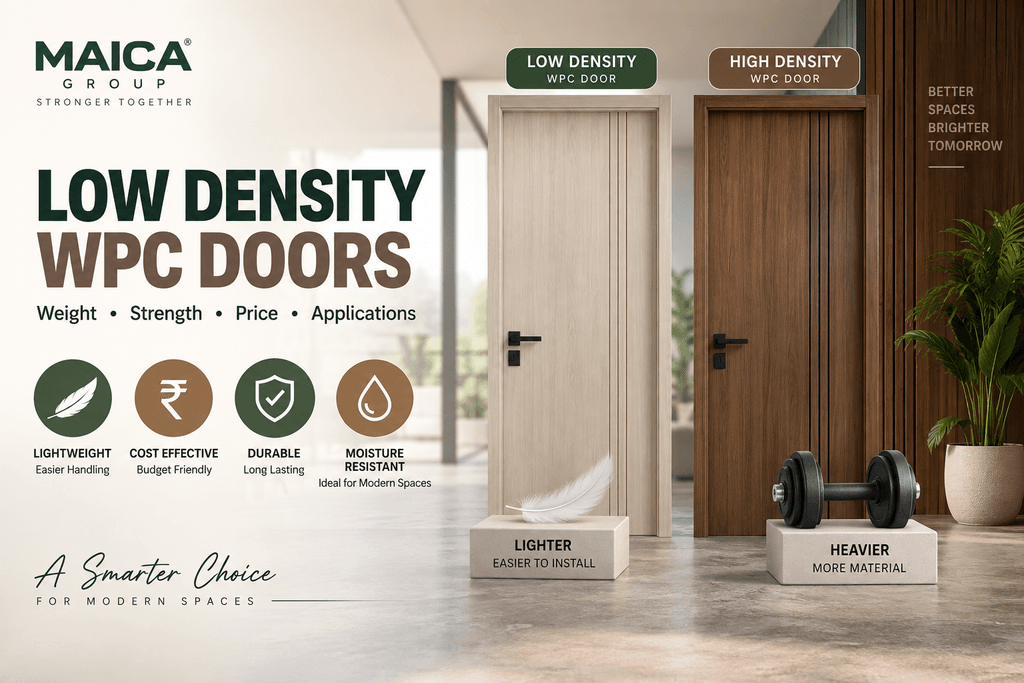
When choosing a WPC door, buyers often focus on design, thickness, waterproofing, durability and price. However, one specification that can significantly influence the performance and cost of a door is density.
This is why terms such as low density WPC doors, lightweight WPC doors and WPC door density are increasingly searched by homeowners, builders, contractors and dealers.
But what exactly does low density mean? Is a low-density WPC door strong enough for everyday use? How does density affect weight and price? And when should you choose a low-density WPC door instead of a higher-density option?
This guide explains these questions in simple terms.
What Is a Low Density WPC Door?
A low-density WPC door is a door manufactured using a Wood Plastic Composite formulation designed to achieve a lower overall material density compared with higher-density WPC products.
WPC, or Wood Plastic Composite, is a composite material made using polymer and wood-based components along with additives and other formulation ingredients.
Density refers to the amount of mass contained within a specific volume of material.
In simple terms:
Higher density generally means more material mass in the same volume, while lower density means less mass in the same volume.
However, density alone does not determine the complete quality of a WPC door.
The formulation, manufacturing process, door thickness, internal structure, reinforcement, surface treatment and intended application should also be considered.
Why Do People Search for Low Density WPC Doors?
There are several reasons buyers search for lightweight or low-density WPC doors.
1. They Want a Lightweight Door
One of the biggest advantages of a lower-density construction can be reduced door weight.
A lighter door can be easier to:
- Transport
- Carry to different floors
- Handle during installation
- Position during fitting
- Install in larger projects
This can be particularly relevant for builders and contractors working on projects with many doors.
2. They Want to Control Project Costs
Large construction projects need to consider the cost of materials, transportation, handling and installation.
A lower-density WPC door may provide an option for projects where weight and material consumption need to be optimized.
However, buyers should compare the complete door specification and performance, rather than choosing a product only because its density is lower.
3. They Need Doors for Interior Applications
Many interior applications do not require the same specifications as high-demand exterior or specialized applications.
For example, lightweight WPC doors may be considered for:
- Bedrooms
- Bathrooms
- Utility rooms
- Office interiors
- Residential apartments
- Rental properties
- Commercial interiors
The correct specification should always be selected according to the application.
How Does Density Affect WPC Door Weight?
Density and weight are closely related.
The basic relationship is:
Mass = Density × Volume
Therefore, if two doors have the same dimensions and similar construction but different material densities, the higher-density product will generally have greater mass.
However, actual door weight also depends on:
- Door dimensions
- Thickness
- Material composition
- Internal structure
- Reinforcement
- Surface treatment
- Accessories or inserts
Therefore, simply asking for the density is not always enough to determine the final door weight.
Low Density vs High Density WPC Doors
Both low-density and high-density WPC doors can have applications depending on project requirements.
| Feature | Low Density WPC Door | Higher Density WPC Door |
|---|---|---|
| Weight | Generally lower | Generally higher |
| Handling | Easier in many applications | Requires more handling effort |
| Material usage | Generally lower | Generally higher |
| Cost consideration | Can be suitable for budget-focused projects | Can involve higher material cost |
| Typical use | Interior and selected project applications | Applications requiring specific structural characteristics |
| Installation | Potentially easier due to lower weight | May require suitable hardware for higher weight |
| Selection criteria | Application, construction and performance | Application, construction and performance |
The important point is that density should be treated as one specification among several, rather than the only measure of quality.
Are Low Density WPC Doors Strong?
This is one of the most common questions buyers ask.
The answer depends on the specific formulation and construction of the door.
A door’s performance is influenced by several factors, including:
- Material formulation
- Polymer and wood-based component ratio
- Manufacturing process
- Door thickness
- Internal structure
- Reinforcement
- Screw-holding capability
- Hardware selection
- Surface finish
- Installation quality
Therefore, a low-density WPC door should not automatically be considered weak, just as a high-density WPC door should not automatically be considered suitable for every application.
The right question is:
Does the door specification provide the required performance for the intended application?
What Are the Benefits of Low Density WPC Doors?
Low-density WPC doors can offer several practical benefits when properly designed for their intended application.
1. Lightweight Construction
Lower material density can help reduce overall door weight.
This can make transportation and installation more convenient.
2. Easier Handling
Workers can generally handle lighter door panels more easily during movement and installation.
This can be particularly useful in multi-storey construction projects.
3. Potential Transportation Savings
When large quantities of doors are transported, weight can become an important logistics consideration.
A lighter product may help optimize transportation and handling, depending on the shipment and transport conditions.
4. Suitable for Selected Interior Applications
Low-density WPC doors can be considered for interior applications where the performance requirements are compatible with the product specification.
5. Project-Specific Cost Optimization
For large projects, buyers may evaluate density as one factor when balancing material cost, weight and performance requirements.
Where Can Low Density WPC Doors Be Used?
The correct application depends on the manufacturer’s technical specification.
Potential applications can include:
Residential Projects
Low-density WPC doors may be considered for:
- Bedrooms
- Internal rooms
- Utility areas
- Bathrooms
- Kitchens
- Apartment interiors
Commercial Buildings
They can also be evaluated for:
- Offices
- Retail spaces
- Restaurants
- Hotels
- Institutional interiors
- Service areas
Builder Projects
Builders handling apartment or housing projects may evaluate lightweight WPC doors because they need to manage:
- Material cost
- Door weight
- Transportation
- Installation time
- Project volume
Dealer and Distributor Markets
Dealers may offer different WPC door specifications according to customer requirements.
This allows customers to select a product based on:
- Budget
- Weight
- Application
- Design
- Thickness
- Density
- Finish
- Performance requirements
Does Low Density Mean Lower Price?
Not necessarily.
Density can influence material consumption and therefore manufacturing economics, but the final price of a WPC door depends on many factors.
These may include:
- Door dimensions
- Thickness
- Density
- Raw material formulation
- Manufacturing process
- Surface finish
- Lamination
- CNC work
- Digital printing
- Moulding
- Hardware
- Packaging
- Transportation
- Order quantity
For this reason, comparing WPC doors only on price per square foot may not provide a complete picture.
A better comparison includes the complete product specification.
How to Choose the Right WPC Door Density
Instead of asking only:
“Which WPC door has the highest density?”
buyers should first identify the application.
Step 1: Identify the Application
Is the door for:
- Bedroom?
- Bathroom?
- Office?
- Hotel?
- Apartment?
- Commercial building?
- High-traffic area?
Step 2: Determine Required Thickness
Door thickness affects weight, stability and overall performance.
Step 3: Consider Weight
If the project involves large quantities or difficult transportation, door weight can become an important factor.
Step 4: Check Construction
Ask the manufacturer about the door’s construction and reinforcement.
Step 5: Check Hardware Compatibility
The hinges, locks, screws and frame should be appropriate for the selected door.
Step 6: Compare Performance
Evaluate:
- Water resistance
- Termite resistance
- Durability
- Screw-holding capability
- Dimensional stability
- Surface finish
- Maintenance requirements
Step 7: Compare Total Cost
Instead of comparing only the purchase price, consider:
Door + Frame + Hardware + Transportation + Installation + Maintenance
This gives a more realistic project cost.
Low Density WPC Door for Bathroom Applications
Bathrooms are one of the areas where WPC doors are frequently considered because WPC is designed to provide moisture-resistant characteristics compared with conventional wood-based door materials.
However, bathroom suitability depends on the actual product specification and installation.
When selecting a WPC bathroom door, buyers should evaluate:
- Water and moisture resistance
- Door thickness
- Frame compatibility
- Hardware
- Edge finishing
- Surface finish
- Ventilation
- Installation conditions
A low-density door can be considered if its technical specifications meet the requirements of the bathroom application.
Low Density WPC Doors for Builders and Bulk Projects
For builders, the purchasing decision is different from that of an individual homeowner.
A builder may need hundreds or thousands of doors.
Therefore, important factors can include:
- Consistent dimensions
- Consistent density
- Batch-to-batch quality
- Door weight
- Manufacturing capacity
- Delivery schedule
- Packaging
- Custom sizes
- Surface finishes
- Door frames
- Technical support
- Bulk pricing
For these projects, it is useful to request a product specification sheet and sample before placing a large order.
What Should You Ask a WPC Door Manufacturer?
Before purchasing low-density WPC doors, ask the manufacturer for clear information about:
Product Specification
- Density
- Thickness
- Standard dimensions
- Weight
- Material composition
- Surface finish
Performance
- Water resistance
- Termite resistance
- Screw-holding capability
- Dimensional stability
- Suitable applications
Manufacturing
- Manufacturing process
- Quality-control process
- Density consistency
- Available sizes
- Customization options
Project Supply
- Minimum order quantity
- Bulk pricing
- Production capacity
- Delivery timeline
- Packaging
- Transportation support
This information makes it easier to compare products from different manufacturers.
Low Density WPC Door: Is It Right for Your Project?
There is no single density that is ideal for every application.
For example, a lightweight interior door may have different requirements from a door used in a high-traffic commercial environment.
Therefore, the correct approach is to select the density and construction according to the intended application.
If your priority is lightweight handling and project cost optimization, a suitable low-density WPC door may be worth evaluating.
If your application requires specific mechanical or structural performance, you should compare different density options and verify the manufacturer’s technical specifications.
Why Choose Maica Group for WPC Doors?
Maica Group manufactures WPC doors and door frames for residential, commercial and project applications.
The company offers different WPC door solutions, including:
- Plain WPC Doors
- Laminated WPC Doors
- Textured WPC Doors
- Digital WPC Doors
- CNC-Digital WPC Doors
- Moulded WPC Doors
- Carved Solid WPC Doors
For project requirements, customers can discuss factors such as:
- Door size
- Thickness
- Density
- Finish
- Design
- Application
- Quantity
This helps identify a specification suitable for the project instead of selecting a door based on density alone.
Frequently Asked Questions About Low Density WPC Doors
What is a low-density WPC door?
A low-density WPC door is manufactured using a WPC formulation designed to have lower material density than higher-density WPC products. The actual performance depends on the formulation and construction.
Are low-density WPC doors durable?
Durability depends on the material formulation, manufacturing process, thickness, construction, reinforcement and intended application.
Are low-density WPC doors waterproof?
WPC doors are commonly selected for moisture-resistant applications, but the exact water-resistance performance depends on the product specification, construction and installation.
Are low-density WPC doors cheaper?
They can be designed for cost optimization, but price depends on density, size, thickness, formulation, finish, manufacturing and order quantity.
Are lightweight WPC doors good for bathrooms?
They can be considered for bathrooms when the manufacturer’s specifications meet the requirements of the application.
What is the difference between low-density and high-density WPC doors?
The primary difference is material density and therefore potentially weight. However, door construction and formulation also influence performance, so density should not be used as the only comparison factor.
How do I select the right WPC door density?
Start with the application, then evaluate required thickness, weight, performance, construction, hardware compatibility and total project cost.
Final Thoughts
Low-density WPC doors are primarily relevant to buyers looking for a balance between weight, cost and required performance.
However, density alone does not define the quality of a WPC door.
A proper evaluation should consider the complete product specification, including density, thickness, construction, material formulation, durability, water resistance, screw-holding capability, finish and intended application.
For homeowners, builders, contractors and dealers, understanding these factors makes it easier to select the right WPC door for a particular project.
If you are comparing different WPC door densities for a residential, commercial or bulk project, speak with the manufacturer and request the technical specifications before making a final selection.
Explore WPC door solutions from Maica Group and discuss your project requirements with our team.