
A door is no longer just a functional part of a building. For many homes, hotels, offices and premium interiors, the door is also an important design element.If you want the functional characteristics of a WPC door with a decorative, three-dimensional appearance, carved WPC doors can be an interesting option.
Carved WPC doors feature decorative patterns machined or carved into the WPC door surface. Depending on the design and manufacturing method, they can create geometric patterns, floral motifs, traditional designs, contemporary lines and other decorative effects.
But how are WPC doors carved? What types of designs are available? Is CNC carving better than manual carving? What affects the price? And how can you identify a good-quality carved WPC door?
This guide explains everything you should know before selecting or ordering carved WPC doors.
What Are Carved WPC Doors?
Carved WPC doors are WPC doors with decorative patterns created on their surface through a carving or machining process.
WPC stands for Wood Plastic Composite. WPC doors are engineered products made from a combination of wood-based material, thermoplastic components and other additives, with the exact formulation varying between manufacturers and products.
The carved design adds another dimension to the basic door.
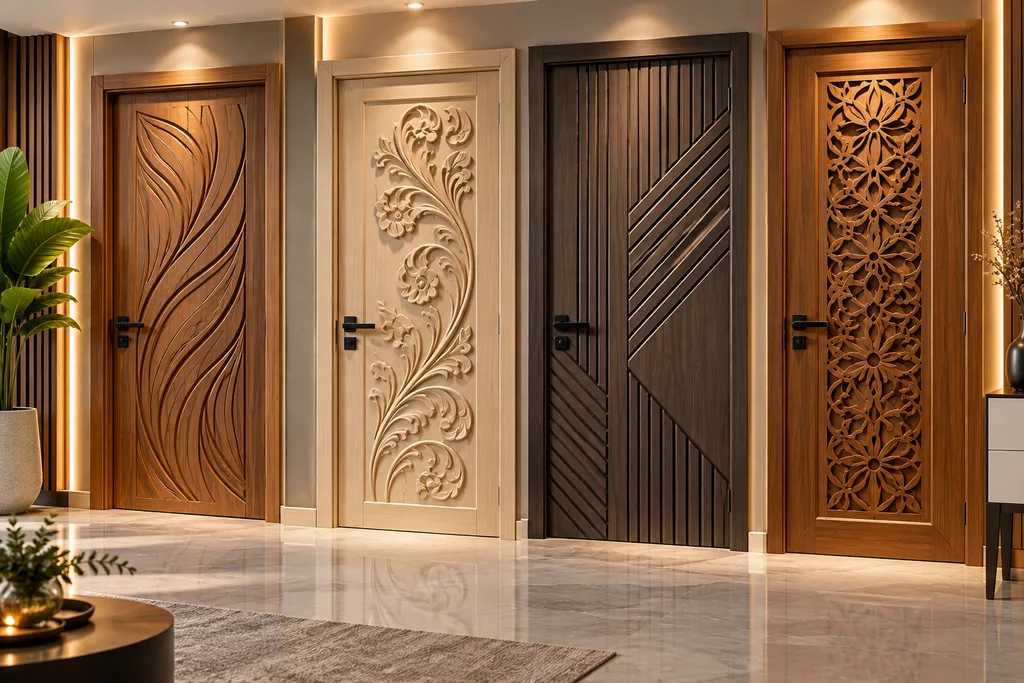
Instead of having a completely flat surface, the door can feature:
- Geometric patterns
- Floral designs
- Decorative lines
- Traditional motifs
- Abstract patterns
- Modern minimalist designs
- Deep or shallow carved details
- Custom patterns
Maica Group currently lists Carved WPC Doors as part of its WPC door range and describes them as doors featuring intricate patterns made with machine precision.
Carved WPC Door vs Plain WPC Door
A plain WPC door generally has a simple surface, while a carved WPC door uses machining or carving to create a decorative pattern.
The choice between the two depends on the desired appearance, application, design requirements and budget.
How Are WPC Doors Carved?
One of the most important questions buyers ask is:
How is carving done on a WPC door?
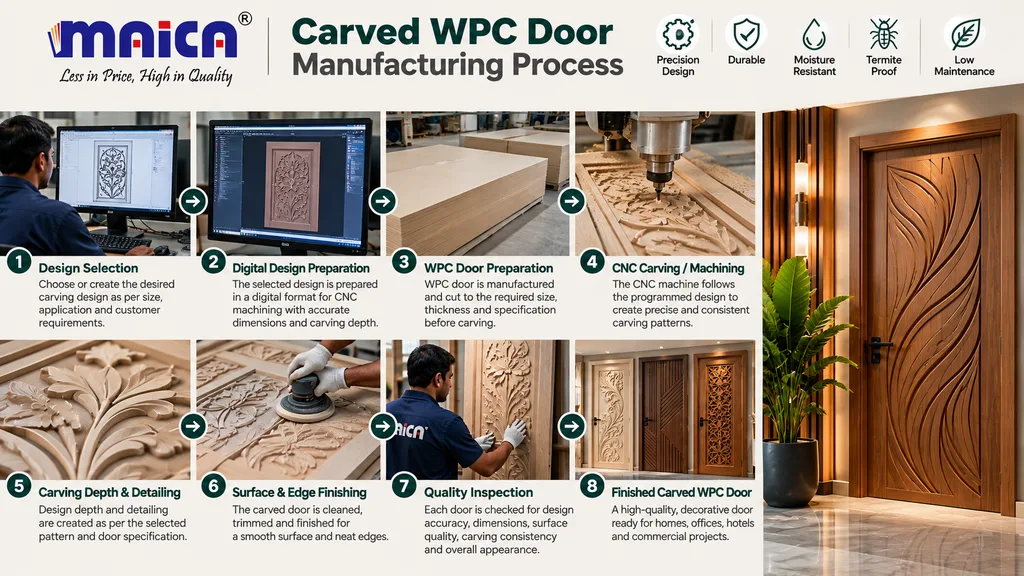
The exact manufacturing process varies according to the door construction, design, machinery and manufacturer’s production system.
A typical CNC carving workflow can include the following stages.
1. Design Selection
The process begins with selecting the desired carving pattern.
The design may be:
- Selected from an existing design catalogue
- Modified from an existing pattern
- Created specifically for a project
- Supplied by the customer, where technically suitable
The design needs to be considered together with the door’s size and construction.
2. Digital Design Preparation
For CNC-carved doors, the design is generally prepared digitally before machining.
The design may contain information about:
- Pattern dimensions
- Lines
- Curves
- Borders
- Carving areas
- Design depth
- Positioning
Digital preparation allows the manufacturer to reproduce a suitable design with greater consistency.
CNC manufacturing is based on programmed machine movements, which is also why CNC technology is commonly used for intricate decorative patterns. Maica describes its carved WPC doors as featuring machine-precision patterns.
3. WPC Door Preparation
The WPC door is prepared according to the required specification.
This can include:
- Door size
- Thickness
- Density/specification
- Surface preparation
- Design area
Maica currently lists WPC door thicknesses from 22 mm to 35 mm and multiple density specifications, including 0.4, 0.5, 0.55, 0.6 and 0.65, on its WPC door page. Actual availability should be confirmed for the selected product and design.
4. CNC Carving or Machining
The digital design is transferred to the CNC machine.
The machine follows the programmed toolpath and removes material from selected areas of the WPC surface to create the required pattern.
This process can be used to create:
- Straight lines
- Curves
- Geometric shapes
- Floral patterns
- Repeated patterns
- Decorative borders
- More detailed designs
The achievable detail depends on factors such as machine capability, tooling, material characteristics, design complexity and required depth.
5. Carving Depth and Detailing
Not every carved door has the same depth.
A design may have relatively shallow decorative lines or more prominent carved areas.
Carving depth can affect:
- Appearance
- Shadow effects
- Design visibility
- Machining time
- Finishing requirements
- Final cost
For this reason, the carving design should be finalized before production.
6. Surface and Edge Finishing
After carving, the door may require additional finishing.
Depending on the product, this can involve:
- Cleaning
- Edge trimming
- Surface finishing
- Removing machining residue
- Inspection
- Additional decorative finishing where specified
The exact finishing process depends on the final product specification.
7. Quality Inspection
The finished door should be checked for:
- Correct dimensions
- Design accuracy
- Carving consistency
- Surface quality
- Edge quality
- Visible defects
- Overall appearance
For repeated designs in a large project, consistency between doors is particularly important.
What Types of Carved WPC Door Designs Are Available?
One of the biggest attractions of carved WPC doors is design flexibility.
Here are some popular design categories.
1. Geometric Carved WPC Doors
Geometric designs use:
- Straight lines
- Rectangles
- Squares
- Angles
- Repeated patterns
- Symmetrical designs
They work particularly well with contemporary and minimalist interiors.
2. Floral Carved WPC Doors
Floral designs can include:
- Flowers
- Leaves
- Vines
- Botanical patterns
- Decorative organic shapes
These designs can create a more traditional or decorative appearance.
3. Traditional Carved WPC Doors
Traditional-inspired designs can incorporate ornamental patterns and decorative detailing.
They may be considered for:
- Pooja rooms
- Traditional interiors
- Villas
- Feature entrances
- Hospitality spaces
4. Modern Minimalist Carved WPC Doors
Minimalist designs generally use simpler patterns.
Examples include:
- Vertical grooves
- Horizontal lines
- Simple rectangles
- Linear patterns
- Abstract shapes
These can work well in modern homes and offices.
5. Abstract Carved WPC Doors
Abstract patterns can be used when the objective is to create a distinctive decorative element rather than replicate a traditional design.
6. Custom Carved WPC Doors
For project requirements, a customer may want a particular design rather than a standard catalogue pattern.
Depending on the manufacturer’s machinery and product capabilities, custom designs may be possible.
The feasibility should be confirmed before production.
What Does a Carved WPC Door Look Like?
The appearance of a carved WPC door depends on the design, carving depth, colour and finishing.
A carved pattern creates areas of light and shadow across the door surface.
This can make the design appear more prominent than a completely flat decorative finish.
Shallow Carving
Creates subtle detailing and can suit minimalist interiors.
Deeper Carving
Can produce stronger shadows and a more dramatic three-dimensional appearance.
Geometric Carving
Creates a clean, structured appearance.
Floral Carving
Creates a decorative and traditional appearance.
The final visual effect also depends on lighting. Directional lighting can make carved patterns appear more pronounced because of the shadows created by the recessed areas.
Carved WPC Doors vs Plain WPC Doors
| Feature | Plain WPC Door | Carved WPC Door |
|---|---|---|
| Surface | Generally flat/simple | Decorative carved pattern |
| Appearance | Simple | More detailed |
| Design element | Limited by surface finish | Carving creates depth |
| Customization | Product dependent | Design-focused |
| Visual effect | Clean/minimal | Decorative/architectural |
| Manufacturing | Standard door production | Requires additional machining |
| Price | Depends on specification | Design and machining can affect price |
| Applications | Residential & commercial | Residential, commercial & decorative applications |
Neither option is universally suitable for every buyer.
A plain WPC door may be appropriate when simplicity and cost control are priorities, while a carved door may be selected when the door itself is intended to become a decorative feature.
Carved WPC Doors vs Laminated WPC Doors
This is another important comparison for buyers.
| Feature | Laminated WPC Door | Carved WPC Door |
|---|---|---|
| Main design element | Decorative surface | Carved pattern |
| Appearance | Colour/pattern focused | Depth and texture focused |
| Wood-grain appearance | Depending on laminate | Depending on finish |
| 3D effect | Depends on surface | Created through carving |
| Design flexibility | Laminate selection | Carving design |
| Main cost factors | Door + laminate | Door + carving/design |
| Best suited for | Decorative surface finish | Decorative architectural detailing |
A buyer should choose according to the desired appearance, application and budget rather than assuming that one finish is automatically better.
For customers comparing both options, see our guide to WPC Laminated Doors.
CNC Carved WPC Doors vs Manual Carving
CNC machining and manual craftsmanship are different production approaches.
| Factor | Manual Carving | CNC Carving |
|---|---|---|
| Production method | Hand-operated | Computer-controlled |
| Design reproduction | Depends on craftsmanship | Program-controlled |
| Repeatability | Depends on craft process | Generally easier to reproduce |
| Complex patterns | Depends on artisan skill | Suitable for programmed designs |
| Bulk production | More difficult to standardize | Suitable for repeated programmed designs |
| Custom designs | Possible | Possible if machine-compatible |
| Accuracy | Craftsmanship dependent | Machine/process dependent |
CNC carving can be particularly useful when the same design needs to be reproduced across multiple doors.
However, the final quality still depends on the machine, tooling, programming, WPC material, finishing and quality-control process.
Benefits of Carved WPC Doors
Carved WPC doors combine the characteristics of the WPC substrate with the visual effect of decorative machining.
1. Decorative Appearance
Carving transforms a simple door surface into a more detailed architectural element.
2. Design Flexibility
Different patterns can be developed for different interior styles.
3. Modern and Traditional Options
The same basic concept can be used for minimalist geometric designs or more elaborate decorative patterns.
4. Three-Dimensional Visual Effect
Carved recesses create natural light-and-shadow effects across the surface.
5. Suitable for Custom Designs
Where manufacturing capability allows, designs can be adapted for specific projects.
6. Suitable for Different Applications
Carved WPC doors can be considered for homes, offices, hospitality spaces and other decorative applications, depending on the product specification.
7. WPC Material Characteristics
The WPC substrate may offer characteristics such as moisture resistance, resistance to termite-related damage and low-maintenance requirements, depending on its formulation and construction.
Maica’s current WPC range describes its doors as waterproof, termite-resistant, low-maintenance and durable, while noting that its range includes plain, laminated, digital, CNC-carved, grooved and moulded variants.
What Affects Carved WPC Door Price?
A common question is:
“How much does a carved WPC door cost?”
There is no single price for every carved WPC door.
The final price can depend on:
- Door size
- Door thickness
- WPC density/specification
- Carving design
- Design complexity
- Carving depth
- Carving area
- CNC machining time
- Tooling
- Surface finishing
- Colour
- Quantity
- Door frame
- Hardware
- Packaging
- Transportation
- Installation requirements
For example, a simple linear pattern may require less machining than an intricate decorative design.
Why Bulk Orders Can Be Different
A project requiring 100 or 500 doors may have different commercial considerations from a single-door order.
For bulk orders, factors such as:
- Standardized design
- Repeatability
- Quantity
- Packaging
- Logistics
- Production planning
can affect the quotation.
Maica’s current product listings include carved WPC door products, with pricing depending on the specific listed product and dimensions; buyers should request a current quotation for their exact size, design and quantity.
How to Choose a Good-Quality Carved WPC Door
Don’t select a carved door based only on its photograph.
Check the complete product specification.
1. Check the WPC Specification
Ask about:
- Density
- Thickness
- Construction
- Intended application
The manufacturer’s specification should be considered rather than comparing density alone. Maica also notes that WPC door performance depends on formulation, manufacturing process, thickness, construction and application.
2. Check the Carving
Look closely at:
- Pattern accuracy
- Depth consistency
- Smoothness
- Corners
- Repeated details
3. Check the Edges
Edge finishing can have a significant impact on the final appearance.
4. Check Dimensions
Confirm:
- Height
- Width
- Thickness
before production.
5. Check the Finish
If the carved door includes an additional finish, confirm exactly what finish is included in the quotation.
6. Request a Physical Sample
For customized and bulk orders, approve the design and physical sample before full production whenever practical.
Can Carved WPC Doors Be Customized?
Yes, customization may be possible depending on the manufacturer’s production capabilities.
Potential customization areas include:
- Door dimensions
- Thickness
- Carving pattern
- Carving depth
- Design area
- Colour
- Surface finish
- Door-frame combination
However, not every design will be technically suitable for every door size or WPC construction.
Before production, the manufacturer should evaluate whether the proposed design is suitable for:
- Door dimensions
- Material
- Machining capability
- Required strength
- Production process
Where Can Carved WPC Doors Be Used?
Carved WPC doors can be considered for a variety of residential and commercial applications.
Homes
They can be used for:
- Bedrooms
- Living rooms
- Pooja rooms
- Decorative interiors
- Selected entrance applications
Villas and Premium Residences
A detailed carved pattern can be used as an architectural feature in a villa or premium residential interior.
Hotels and Resorts
Customized or standardized carved designs can be used to create a consistent interior theme.
Offices
Geometric and minimalist carved designs can suit contemporary office interiors.
Commercial Projects
Depending on the specification, carved WPC doors can be considered for:
- Restaurants
- Retail spaces
- Offices
- Hospitality projects
- Institutional interiors
Carved WPC Doors for Builders and Bulk Projects
For builders, contractors and developers, selecting a carved WPC door involves more than choosing a design.
A large project may require hundreds of doors with consistent:
- Dimensions
- Thickness
- Density/specification
- Design
- Carving depth
- Colour
- Finish
This makes sample approval and production consistency particularly important.
Before placing a bulk order, discuss:
- Door size
- Door thickness
- WPC specification
- Carving design
- Carving depth
- Finish
- Door-frame requirement
- Hardware
- Quantity
- Packaging
- Delivery location
- Project schedule
Maica Group states that its WPC doors and frames are manufactured in Indore and supplied for residential, commercial and project applications.
Carved WPC Doors and WPC Door Frames
The door shutter is only one part of the complete door opening.
The frame affects:
- Door alignment
- Hinge installation
- Overall appearance
- Installation
- Door operation
For projects, buyers may therefore consider matching the carved WPC door with an appropriate WPC door frame.
Read more about WPC Door Frames.
Why Buy Carved WPC Doors Directly From a Manufacturer?
Buying directly from a manufacturer can make technical discussions easier, particularly for customized or bulk requirements.
Potential advantages include:
- Direct specification discussion
- Design feasibility discussion
- Sample approval
- Custom design discussion
- Bulk-order support
- Project quotations
- Production coordination
- Direct communication
However, buyers should still evaluate the actual product sample, specifications, commercial terms and manufacturing capabilities before placing an order.
Why Choose Maica Group for Carved WPC Doors?
Maica Group / Maica Plastiwood Private Limited is based in Indore, Madhya Pradesh, India, and manufactures WPC Doors and WPC Door Frames for residential, commercial and project applications. Its current WPC door range includes plain, laminated, digital, CNC-carved, grooved and moulded variants.
Maica’s current WPC door specifications include multiple door sizes, thicknesses and density options, allowing requirements to be discussed according to the application and selected design.
For customized or bulk requirements, buyers can discuss:
- Carving design
- Door size
- Thickness
- WPC specification
- Finish
- Quantity
- Door-frame requirements
- Project requirements
Frequently Asked Questions About Carved WPC Doors
1. What are carved WPC doors?
Carved WPC doors are WPC doors featuring decorative patterns created through carving or machining on the door surface.
2. How are WPC doors carved?
The door can be machined using suitable carving equipment. For CNC-carved doors, the design is prepared digitally and the CNC machine follows the programmed toolpath to create the pattern.
3. Are carved WPC doors CNC carved?
Some carved WPC doors are CNC machined, but not every carved WPC door necessarily uses CNC technology. The manufacturing method depends on the manufacturer and product.
4. What types of carved WPC door designs are available?
Common design categories include geometric, floral, traditional, abstract, linear and minimalist patterns. Custom designs may also be possible depending on manufacturing capabilities.
5. Can I provide my own carving design?
A custom design may be possible if it is compatible with the manufacturing process, door dimensions and WPC construction. Discuss the design with the manufacturer before production.
6. How much do carved WPC doors cost?
Price depends on door size, thickness, WPC specification, design complexity, carving depth, machining, finish, quantity, frame, hardware and other requirements. A quotation should be requested for the exact specification.
7. Are carved WPC doors waterproof?
The answer depends on the complete WPC product specification and construction. A carved surface does not by itself determine the door’s moisture performance.
8. Are carved WPC doors termite resistant?
WPC products can provide resistance to termite-related damage depending on their formulation and construction. Buyers should verify the specific manufacturer’s product specification.
9. Can carved WPC doors be used in bathrooms?
They may be suitable for bathroom applications when the complete product construction, finish and installation are appropriate for the environment. Confirm the manufacturer’s specification before ordering.
10. Can carved WPC doors be used for hotels?
Yes, they can be considered for hotel and hospitality applications where the selected door specification meets the project’s design and functional requirements.
11. Can carved WPC doors be customized?
Customization may be available for dimensions, patterns, carving and finishes depending on the manufacturer’s production capabilities.
12. Can carving be done on both sides?
Two-sided carving may be possible for certain door constructions, but it should be confirmed with the manufacturer before production.
13. Are carved WPC doors suitable for bulk orders?
Yes. They can be considered for residential developments, hotels, commercial projects and other applications requiring multiple doors with consistent designs.
14. How do I check the quality of a carved WPC door?
Check the WPC specification, thickness, dimensions, carving accuracy, carving depth, surface quality, edges, finish and overall consistency. A physical sample is recommended for customized or bulk orders.
15. Where can I buy carved WPC doors in India?
Carved WPC doors are available through manufacturers, dealers and distributors. Maica Group manufactures WPC doors in Indore, Madhya Pradesh, and accepts enquiries for residential, commercial and project requirements.
Final Thoughts
A carved WPC door can turn a functional door into a distinctive interior feature.
The biggest advantage of carved designs is the ability to create depth, texture and visual detail while using a WPC door substrate.
However, the design should not be the only consideration.
Before ordering, evaluate:
- WPC specification
- Door thickness
- Dimensions
- Carving quality
- Design complexity
- Surface finish
- Edge finishing
- Quantity
- Project requirements
- Manufacturer capability
For customized and bulk orders, it is particularly useful to finalize the design and approve a physical sample before production.
Looking for Carved WPC Doors?
If you are planning a home, villa, hotel, resort, commercial building or bulk construction project, Maica Group can discuss your carved WPC door requirements.
Share your:
- Required door size
- Thickness
- Preferred carving design
- Quantity
- Finish/colour
- Door-frame requirement
- Delivery location
with the Maica Group team to discuss suitable specifications and obtain a quotation.
Request Carved WPC Door Design & Quotation
Maica Group
Indore, Madhya Pradesh, India
Website: Maica Group
For more updates follow us: