
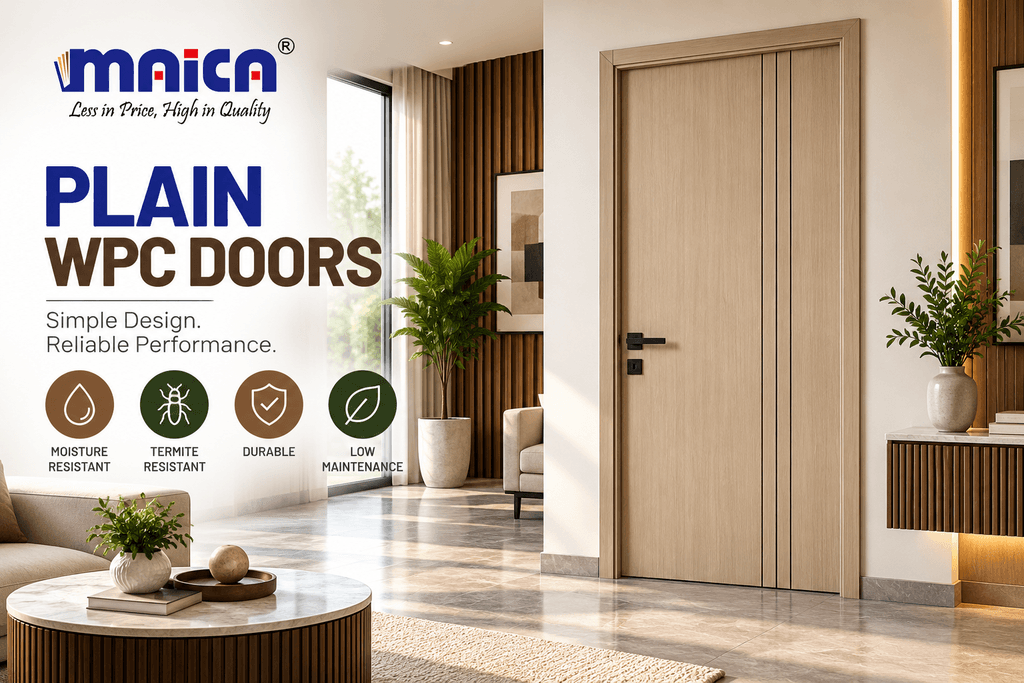
If you are looking for a door with a clean, simple and modern appearance, plain WPC doors can be a practical option for residential, commercial and project applications. Unlike decorative doors with elaborate patterns, plain WPC doors feature a simple surface that can easily complement different interior styles.
Today, homeowners, builders, contractors, architects, interior designers and dealers are increasingly exploring plain WPC doors because they combine a minimalist appearance with the practical characteristics associated with WPC construction.
But what exactly is a plain WPC door? How is it different from laminated or moulded WPC doors? Are plain WPC doors suitable for bathrooms and bedrooms? How much does a plain WPC door cost?
This guide covers the benefits, applications, price factors, sizes, thickness, comparisons and buying considerations you should understand before selecting plain WPC doors.
What Are Plain WPC Doors?
Plain WPC doors are doors manufactured using Wood Plastic Composite (WPC) and designed with a simple, clean surface without elaborate decorative patterns.
The word “plain” refers primarily to the appearance and finish of the door, not to a lower level of quality.
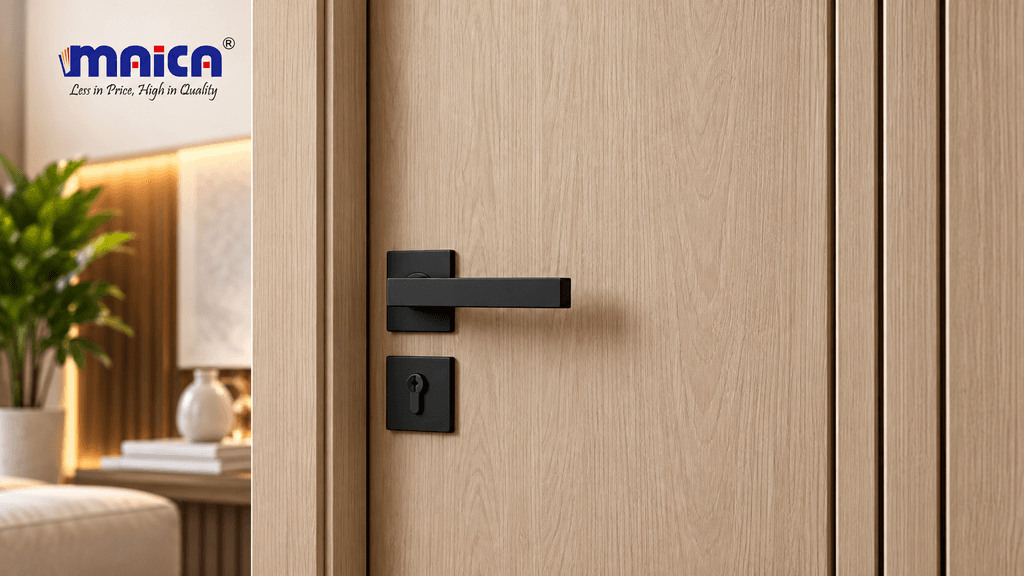
A plain WPC door is an excellent choice when you want a simple, uncluttered look with a material built for demanding interior applications.
Plain WPC doors are commonly considered for:
- Bedrooms
- Bathrooms
- Utility areas
- Offices
- Apartments
- Hotels
- Rental properties
- Commercial buildings
- Residential projects
- Bulk construction projects
The final suitability of any WPC door depends on its construction, thickness, density, finish, hardware and installation requirements.
Why Are Plain WPC Doors Becoming Popular?
Modern interior design increasingly focuses on minimalism and functionality.
Instead of choosing a heavily decorative door for every room, many buyers prefer a simple door that blends naturally with the walls, furniture and overall interior design.
Plain WPC doors can be attractive for several reasons.
1. Clean and Minimal Appearance
A plain surface creates a simple visual appearance that works well with modern interiors.
It can be paired with:
- Modern furniture
- Neutral walls
- Wooden flooring
- Contemporary hardware
- Minimalist interiors
- Commercial office designs
2. Easy to Coordinate With Different Interiors
Because the design is simple, plain doors can work with a wide variety of interior themes.
This is particularly useful for builders and contractors who need a consistent door style across multiple rooms or units.
3. Practical for Everyday Applications
Plain doors are often selected where functionality is more important than elaborate decoration.
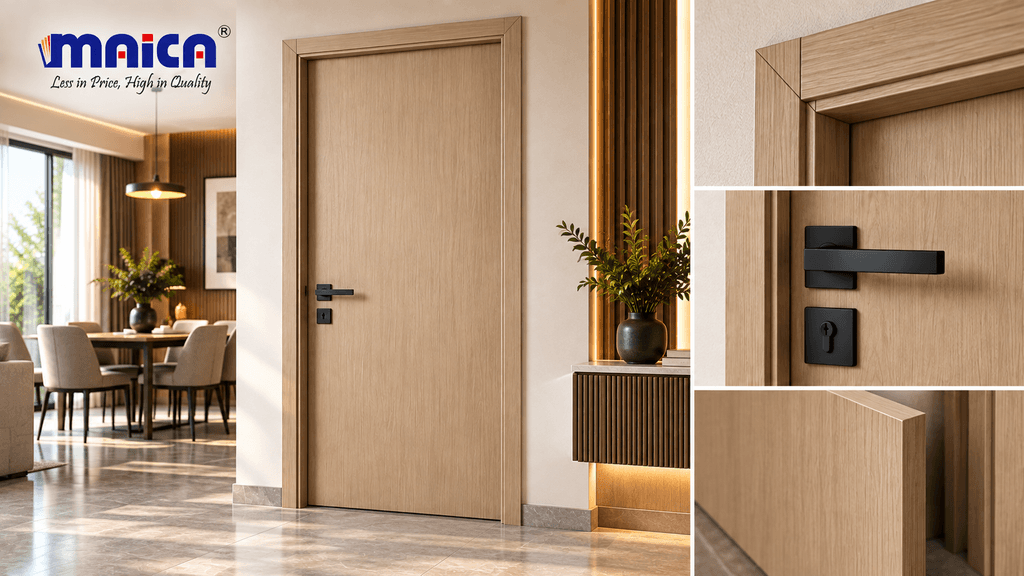
For example, a customer may prefer a simple WPC door for a:
- Bathroom
- Bedroom
- Store room
- Utility room
- Office
- Rental property
4. Suitable for Project Applications
Large projects often require consistency.
Instead of selecting different decorative designs for every room, a project developer may choose a simple door design across multiple units.
This can simplify:
- Procurement
- Installation
- Inventory management
- Design coordination
- Replacement requirements
Key Benefits of Plain WPC Doors
1. Clean and Modern Design
One of the biggest advantages of plain WPC doors is their simplicity.
The absence of elaborate patterns makes them suitable for customers who prefer a modern and understated appearance.
A simple door can also make it easier to change the surrounding interior design later without having to replace the door.
2. Moisture-Resistant Characteristics
WPC is commonly selected for areas where moisture exposure is a concern.
This is one reason WPC doors are considered for applications such as bathrooms and other interior spaces where conventional wood may require more protection and maintenance.
However, buyers should distinguish between water-resistant, moisture-resistant and waterproof claims.
Actual performance can depend on:
- Door construction
- Material formulation
- Surface treatment
- Edges
- Frame
- Installation
- Hardware
Therefore, always confirm the manufacturer’s specifications for your intended application.
3. Termite Resistance
Termite resistance is another reason customers consider WPC as an alternative to conventional wood-based door materials.
For projects in areas where termite concerns are significant, buyers often evaluate WPC doors as part of their material selection.
However, the exact performance should always be evaluated according to the manufacturer’s product specification.
4. Low-Maintenance Characteristics
Plain WPC doors can be attractive for customers looking for a door solution that does not require the same type of routine maintenance associated with some traditional wooden finishes.
The simple surface of a plain door can also make routine cleaning straightforward.
Maintenance requirements will depend on the particular finish and installation conditions.
5. Suitable for Modern Interiors
Plain WPC doors work particularly well with minimalist interior concepts.
They can be used in:
- Modern apartments
- Contemporary homes
- Offices
- Hotels
- Commercial spaces
- Rental properties
- Institutional interiors
Their simple appearance allows other design elements—such as furniture, lighting, flooring and wall finishes—to remain the visual focus.
6. Easy to Coordinate Across Multiple Rooms
For a residential or commercial project, consistency can be important.
A single plain WPC door style can provide a uniform appearance across:
- Bedrooms
- Bathrooms
- Utility areas
- Offices
- Guest rooms
- Apartments
This makes plain doors particularly relevant for builders and project contractors.
7. Practical for Bulk Projects
Plain WPC doors can be considered for projects requiring a large number of doors.
For bulk buyers, factors such as:
- Consistent dimensions
- Consistent finish
- Availability
- Manufacturing capacity
- Delivery
- Packaging
- Door frames
- Hardware compatibility
can be as important as the appearance of the door itself.
Plain WPC Doors vs Other WPC Door Types
Plain WPC doors are only one category within the broader WPC door market.
Different customers have different design requirements.
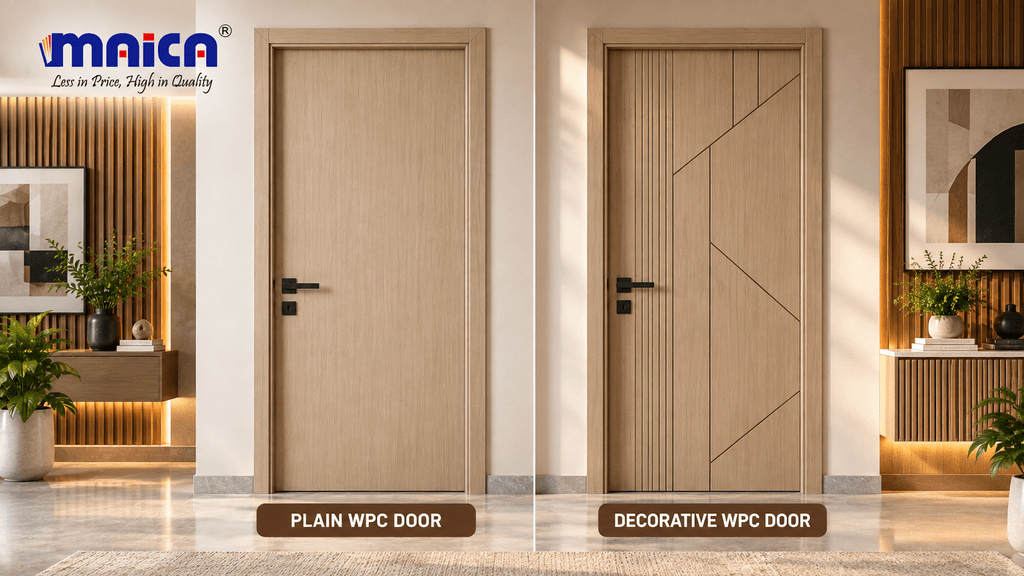
| WPC Door Type | Appearance | Typical Application | Design Requirement |
|---|---|---|---|
| Plain WPC Door | Clean and minimal | Homes, offices, bathrooms, projects | Simple |
| Laminated WPC Door | Decorative wood-look finish | Homes and commercial interiors | Decorative |
| Textured WPC Door | Patterned/textured surface | Modern interiors | Medium/High |
| Digital WPC Door | Printed decorative design | Customized interiors | High |
| CNC-Digital WPC Door | Detailed CNC + digital design | Premium interiors | Very High |
| Moulded WPC Door | Panelled/decorative | Traditional and modern spaces | Medium |
| Carved WPC Door | Detailed carved appearance | Premium/luxury spaces | High |
The right option depends on the design, budget and application.
A plain WPC door is not necessarily “better” than a decorative door. It is simply a different design solution.
Plain WPC Doors vs Wooden Doors
Wooden doors remain popular because of their traditional appearance and natural character.
However, buyers evaluating doors for modern construction may compare WPC and wood based on several factors.
| Factor | Plain WPC Door | Wooden Door |
|---|---|---|
| Appearance | Clean, modern | Natural/traditional |
| Moisture considerations | Suitable for moisture-focused applications depending on specification | Depends heavily on wood and treatment |
| Termite concerns | WPC is commonly selected for termite-resistant applications | Requires appropriate protection |
| Maintenance | Generally low maintenance | Depends on wood and finish |
| Design | Plain and customizable options | Wide range |
| Project consistency | Useful for standardized projects | Depends on sourcing/manufacturing |
| Application | Residential and commercial | Residential and commercial |
The best choice depends on the project’s specific requirements.
Plain WPC Doors vs PVC Doors
WPC and PVC doors are both used in modern construction, but they are different materials.
WPC stands for Wood Plastic Composite, while PVC stands for Polyvinyl Chloride.
When comparing the two, buyers should evaluate:
- Material composition
- Door construction
- Thickness
- Weight
- Strength requirements
- Surface finish
- Design
- Moisture exposure
- Hardware compatibility
- Application
- Budget
Rather than choosing a door based only on material name, compare the complete product specification.
Are Plain WPC Doors Waterproof?
This is one of the most common questions buyers ask.
WPC doors are widely selected for applications where moisture resistance is important.
However, the term “waterproof” should be evaluated in the context of the actual product specification.
A door’s performance can depend on:
- Material formulation
- Door construction
- Surface
- Edges
- Frame
- Hardware
- Installation
- Exposure conditions
Therefore, if you are purchasing plain WPC doors for bathrooms, kitchens or other moisture-prone areas, ask the manufacturer about the recommended application and product specifications.
Are Plain WPC Doors Termite Resistant?
WPC doors are commonly considered where termite resistance is an important requirement.
This is one of the reasons WPC is increasingly evaluated as an alternative to traditional wood-based materials.
For a project where termite resistance is a critical requirement, buyers should request the relevant product specifications from the manufacturer rather than relying only on generic material claims.
Plain WPC Door Sizes and Thickness
Door size and thickness are important when selecting a WPC door.
You should consider:
- Door height
- Door width
- Door thickness
- Door weight
- Density
- Frame dimensions
- Hinge requirements
- Lock compatibility
- Installation method
Maica Group’s current WPC door range lists multiple size and thickness options. The company’s WPC door page currently lists heights from 72 to 90 inches, widths from 30 to 48 inches, and thicknesses from 22 mm to 35 mm. It also lists multiple density options. Availability should be confirmed for the exact product, design and quantity required.
For a project order, always provide the manufacturer with the exact required dimensions before requesting a quotation.
Plain WPC Door Price
The price of a plain WPC door can vary considerably depending on the product specification.
There is no single price that applies to every plain WPC door.
Important price factors include:
1. Door Size
Larger doors generally require more material and may have different pricing.
2. Thickness
Thickness can affect material consumption, weight and the final specification.
3. Density
Different density options can influence the material and weight characteristics of the door.
4. Finish
A basic plain finish and a specialized decorative finish may have different costs.
5. Quantity
Bulk project orders may have different commercial terms from individual orders.
6. Customization
Custom dimensions, designs or special requirements can influence the quotation.
7. Door Frame
Buying the door together with a compatible WPC door frame changes the total project cost.
8. Hardware
Hinges, locks and other hardware may be included or quoted separately depending on the supplier.
9. Transportation
Shipping and delivery location can influence the final landed cost.
10. Installation
Installation requirements should also be considered when calculating the complete project cost.
For the latest plain WPC door price, buyers should request a project-specific quotation from the manufacturer.
Looking for a plain WPC door quotation?
Share your required:
- Door size
- Thickness
- Quantity
- Colour/finish
- Door frame requirement
- Delivery location
with Maica Group to discuss your project requirements and obtain a suitable quotation.
Simple WPC Doors for Different Applications
Plain WPC Doors for Homes
Plain WPC doors can work well in modern homes where the customer prefers a simple and coordinated interior.
Potential applications include:
- Bedrooms
- Bathrooms
- Utility rooms
- Kitchens
- Storage areas
- Internal rooms
The final selection should depend on the specific room and product specification.
Plain WPC Doors for Bathrooms
Bathrooms require materials that can handle moisture and frequent cleaning.
This is why WPC doors are commonly considered for bathroom applications.
For bathroom installation, evaluate:
- Moisture resistance
- Door thickness
- Frame
- Hinges
- Lock
- Edge finishing
- Installation
A simple plain design can also complement minimalist bathroom interiors.
Plain WPC Doors for Bedrooms
Bedrooms often require a balance between privacy, appearance and durability.
A plain WPC door can provide a clean background that works with many interior styles.
It can be paired with:
- Wooden furniture
- Modern wardrobes
- Neutral walls
- Contemporary flooring
- Minimalist hardware
Plain WPC Doors for Offices
Offices often benefit from simple, professional-looking doors.
Plain WPC doors can be considered for:
- Cabins
- Meeting rooms
- Internal offices
- Utility areas
- Commercial interiors
The final specification should be selected according to usage intensity and project requirements.
Plain WPC Doors for Hotels
Hotels need a consistent appearance across rooms while also considering durability, maintenance and operational requirements.
Plain WPC doors can be evaluated for selected hotel applications where a simple, consistent design is preferred.
Plain WPC Doors for Apartments
Apartment projects often involve a large number of internal doors.
For builders and developers, a standardized plain door can simplify procurement and design coordination.
Important considerations include:
- Quantity
- Consistent size
- Consistent finish
- Delivery schedule
- Door frames
- Hardware
- Installation
Plain WPC Doors for Commercial Projects
Commercial projects may include:
- Offices
- Retail spaces
- Hotels
- Educational buildings
- Healthcare facilities
- Institutional buildings
For such projects, door selection should consider expected usage, moisture exposure, maintenance and hardware requirements.
Why Builders and Contractors Choose Plain WPC Doors
For a homeowner, one door may be the entire purchase.
For a builder, a project may require hundreds of doors.
That makes procurement and consistency extremely important.
Builders and contractors may consider plain WPC doors because a standardized design can simplify:
Project Standardization
The same door style can be used across multiple rooms or units.
Procurement
A standardized specification can simplify purchasing.
Installation Planning
Consistent dimensions can make installation planning easier.
Bulk Requirements
Manufacturers can discuss project-specific quantities and requirements.
Door + Frame Procurement
Buying compatible doors and frames from the same supplier can simplify coordination.
Design Consistency
A simple door can maintain a uniform appearance across a project.
Plain WPC Door Frame: Why the Frame Matters
Choosing the door without considering the frame can create installation and compatibility problems.
The door and frame should be evaluated together.
Important factors include:
- Opening dimensions
- Frame section
- Door thickness
- Hardware
- Hinges
- Alignment
- Installation
- Finish
- Overall project consistency
A compatible WPC door frame can also help maintain a consistent appearance between the door and surrounding structure.
For large projects, specifying the door and frame together can simplify procurement and installation planning.
How to Choose the Right Plain WPC Door
Before ordering, use this checklist.
1. Identify the Application
Determine where the door will be installed.
Bedroom, bathroom, office and commercial applications may have different requirements.
2. Select the Correct Size
Confirm:
- Width
- Height
- Thickness
- Opening size
3. Consider Density
Density can influence the weight and material characteristics of a door.
Select according to the intended application and manufacturer specification rather than choosing solely on the density number.
4. Check Door Weight
Door weight matters for:
- Transportation
- Handling
- Hinges
- Installation
- Frame compatibility
5. Select the Finish
Plain does not necessarily mean one colour.
Choose a finish that works with your interior.
6. Check the Frame
Ensure the WPC door frame is compatible with the selected door.
7. Check Hardware
Confirm that:
- Hinges
- Locks
- Screws
- Handles
are appropriate for the selected door specification.
8. Consider Quantity
If you are ordering for a project, inform the manufacturer of the complete quantity before requesting the quotation.
9. Request Product Specifications
Ask the manufacturer for the relevant technical details before placing a large order.
10. Evaluate a Sample
For large projects, evaluating a sample before finalizing a bulk order can help confirm the appearance, finish and suitability.
Why Choose Maica Group for Plain WPC Doors?
Maica Group is an Indian manufacturer of WPC doors and WPC door frames, with manufacturing operations in Indore, Madhya Pradesh.
The company offers multiple WPC door categories, including:
- Plain WPC Doors
- Laminated WPC Doors
- Textured WPC Doors
- Digital WPC Doors
- CNC-Digital WPC Doors
- Moulded WPC Doors
- Carved WPC Doors
Maica’s current plain WPC door range includes simple, modern finishes in colours such as Brown, Dark Brown, Ivory and Teak.
The company supplies WPC doors for residential, commercial and project requirements and works with homeowners, builders, contractors, architects, interior designers, dealers and distributors.
For project requirements, customers can discuss:
- Door size
- Thickness
- Density
- Finish
- Colour
- Quantity
- Door frame requirements
- Application
- Delivery location
This allows the door specification to be selected according to the actual project rather than choosing only on appearance or price.
Plain WPC Doors for Dealers and Distributors
Dealers and distributors often need products that can serve different customer segments.
Plain WPC doors can be an important category because they appeal to customers looking for:
- Simple designs
- Practical doors
- Budget-conscious options
- Residential applications
- Bathroom doors
- Rental properties
- Builder projects
- Bulk requirements
Dealers can also offer customers different WPC door categories, including plain, laminated, textured, digital and moulded options.
If you are a dealer, distributor or retailer looking for a WPC door manufacturer, discuss your required sizes, quantities, designs and market requirements with the manufacturer before finalizing your product range.
Frequently Asked Questions About Plain WPC Doors
What is a plain WPC door?
A plain WPC door is a Wood Plastic Composite door with a simple, clean surface without elaborate decorative patterns. It is commonly selected for minimalist residential and commercial interiors.
Are plain WPC doors waterproof?
WPC doors are commonly selected for moisture-prone applications, but actual water-resistance performance depends on the product construction, surface, edges, frame and installation. Check the manufacturer’s specifications for the intended application.
Are plain WPC doors termite resistant?
WPC doors are commonly selected where termite resistance is required. However, buyers should verify the manufacturer’s specific product claims and specifications.
Are plain WPC doors suitable for bathrooms?
Yes, plain WPC doors can be considered for bathroom applications because moisture resistance is one of the characteristics associated with WPC. The exact product should be selected according to the manufacturer’s recommended application.
How much does a plain WPC door cost?
The price depends on size, thickness, density, finish, quantity, customization, frame, hardware, transportation and installation. A project-specific quotation is the best way to determine the current price.
What thickness is available in plain WPC doors?
Maica Group currently lists WPC door thickness options ranging from 22 mm to 35 mm. The appropriate thickness depends on the application and available product specification.
Are plain WPC doors suitable for bedrooms?
Yes. Their simple appearance makes them suitable for modern bedroom interiors, subject to the selected product specification.
Are plain WPC doors better than wooden doors?
Neither is automatically better for every application. WPC and wood have different characteristics. The right choice depends on moisture exposure, termites, maintenance, design, budget and project requirements.
Can plain WPC doors be customized?
Customization depends on the manufacturer and product range. Buyers should discuss dimensions, colours, thicknesses and other requirements directly with the manufacturer.
Can I buy plain WPC doors in bulk?
Yes. Plain WPC doors can be considered for bulk residential, commercial and builder projects. For large orders, discuss quantity, dimensions, specifications, delivery and pricing with the manufacturer.
Can I get matching WPC door frames?
Yes. WPC door frames can be specified along with the door to improve compatibility and simplify project procurement.
How do I order plain WPC doors from a manufacturer?
Share your required door size, thickness, quantity, colour/finish, frame requirement and delivery location with the manufacturer. The manufacturer can then advise on suitable specifications and provide a project quotation.
Final Thoughts: Are Plain WPC Doors Right for You?
Plain WPC doors are a practical option for customers who want a simple, modern appearance combined with the functional characteristics of WPC.
They can be considered for homes, bathrooms, bedrooms, offices, apartments, hotels, commercial spaces and bulk construction projects.
The biggest advantage of a plain design is its versatility. It can blend into different interiors without becoming the dominant decorative element.
However, selecting the right door involves more than choosing a design.
Before purchasing, evaluate:
Size + Thickness + Density + Weight + Finish + Frame + Hardware + Application + Quantity + Manufacturer
For homeowners, builders, contractors, architects, dealers and distributors, this approach makes it easier to select a door that matches the actual project requirements.
If you are looking for plain WPC doors in India, Maica Group can help you discuss your required size, thickness, finish, quantity and project requirements.
Looking for Plain WPC Doors?
Whether you need doors for a home, apartment project, commercial building or bulk requirement, contact Maica Group to discuss your specifications and request a quotation.
Maica Group — WPC Doors & WPC Door Frames Manufacturer
Read this article to learn more about WPC Doors.