
Introduction
WPC doors are widely used in modern construction.
They are popular because of their durability, moisture resistance, and low maintenance.
Many homeowners, builders, and contractors prefer WPC doors over traditional wooden doors.
This shift is mainly due to better performance in humid and termite-prone environments.
However, there is a common misunderstanding.
People often believe that WPC doors are completely problem-free.
That is not true.
Like any engineered material, WPC doors can face issues.
These issues usually arise due to poor manufacturing, low-quality raw materials, or improper installation.
In many cases, the problem is not the material itself.
It is the way the product is made or used.
Understanding these problems is important.
It helps in making better decisions and avoiding long-term damage.
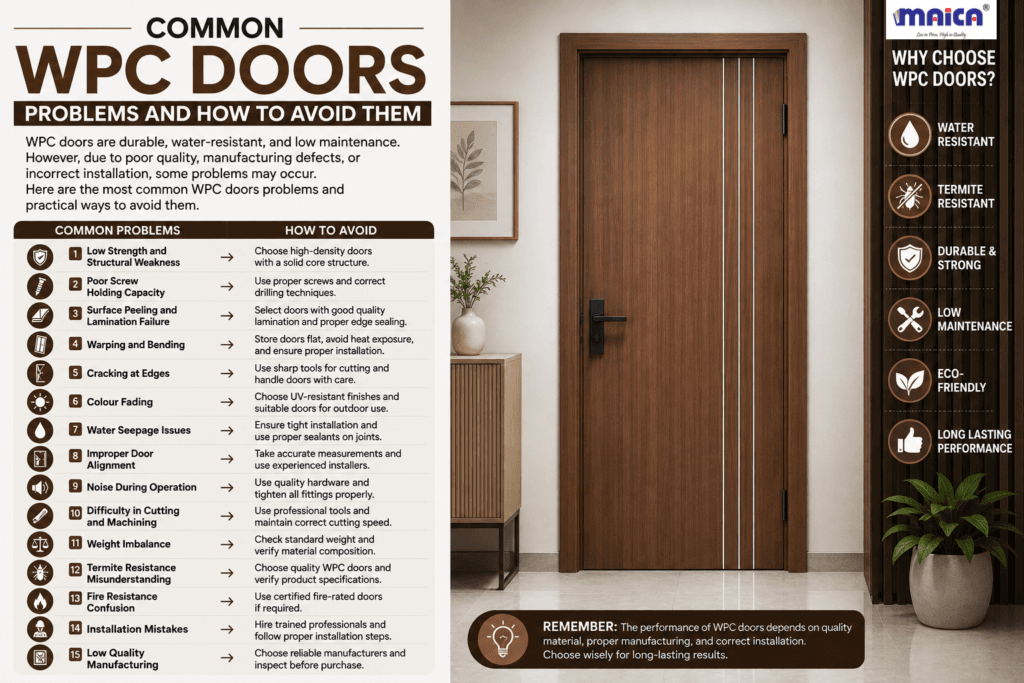
This guide explains the most common WPC doors problems.
It also provides practical ways to prevent them.
Understanding WPC Doors
WPC stands for Wood Plastic Composite.
It is a combination of:
- Wood fibres or wood flour
- Thermoplastics such as PVC or HDPE
- Additives and stabilisers
This combination creates a material that is:
- Resistant to moisture
- Less prone to termite attacks
- More stable than natural wood
However, performance depends heavily on:
- Material composition
- Manufacturing process
- Density and structure
If any of these factors are compromised, problems can occur.
Why WPC Doors Face Problems
Before discussing individual problems, it is important to understand the root causes.
Most issues occur due to:
- Low density material
- Excess filler (like calcium carbonate)
- Poor extrusion process
- Improper cooling
- Weak bonding between materials
- Incorrect installation practices
- Lack of quality inspection
When these factors are ignored, the durability of WPC doors reduces significantly.
1. Low Strength and Structural Weakness
Problem
Some WPC doors feel weak and unstable.
They may bend under pressure or develop cracks over time.
Cause
This usually happens when:
- The density of the material is too low
- Excess filler is added to reduce cost
- The internal structure is not uniform
Low-density WPC lacks strength.
It cannot handle regular usage effectively.
How to Avoid
- Always check the weight of the door
- Avoid extremely lightweight doors
- Ask for density specifications
- Prefer solid core WPC doors
A strong WPC door should feel firm and balanced.
2. Poor Screw Holding Capacity
Problem
Screws become loose after installation.
Handles, locks, and hinges may not stay fixed.
Cause
This happens due to:
- Weak internal bonding
- Low-density material
- Poor extrusion quality
If the material cannot hold screws properly, hardware performance suffers.
How to Avoid
- Test screw grip before installation
- Use proper drilling techniques
- Avoid over-tightening screws
- Choose high-density WPC doors
Good screw holding capacity is a sign of quality.
3. Surface Peeling and Lamination Failure
Problem
The surface layer starts peeling.
The finish becomes dull or uneven.
Cause
- Low-quality adhesive
- Improper lamination process
- Moisture trapped during manufacturing
Poor bonding between layers leads to surface failure.
How to Avoid
- Inspect surface finish before purchase
- Avoid doors with visible bubbles or patches
- Ensure proper edge sealing
- Handle doors carefully during transport
A well-laminated surface should be smooth and firm.
4. Warping and Bending
Problem
The door changes shape over time.
It may not close properly.
Cause
- Uneven cooling during manufacturing
- Exposure to high heat
- Improper storage conditions
Even a slight imbalance in structure can cause bending.
How to Avoid
- Store doors in a flat position
- Avoid direct sunlight before installation
- Ensure proper frame alignment
- Install doors using professional methods
Correct installation reduces stress on the door.
5. Cracking at Edges
Problem
Edges crack during cutting or use.
Cause
- Low-quality material
- Improper machining
- High filler content
Edges are the most vulnerable parts of a door.
How to Avoid
- Use sharp and suitable cutting tools
- Avoid rough handling
- Check edge strength before installation
Proper finishing improves durability.
6. Colour Fading
Problem
The colour becomes dull over time.
Cause
- Poor pigments
- Lack of UV stabilisers
- Continuous exposure to sunlight
Low-quality colour additives cannot resist environmental conditions.
How to Avoid
- Choose UV-resistant finishes
- Avoid cheap laminated surfaces
- Use suitable doors for outdoor areas
Colour stability depends on material quality.
7. Water Seepage Issues
Problem
Water enters through joints or gaps.
Cause
- Poor installation
- Lack of sealing
- Gaps between frame and wall
Even water-resistant materials can fail if joints are weak.
How to Avoid
- Use proper sealants
- Ensure tight installation
- Inspect all joints carefully
Water protection depends on fitting quality.
8. Improper Door Alignment
Problem
The door does not fit correctly.
It may rub against the frame.
Cause
- Incorrect measurements
- Uneven walls
- Poor installation techniques
Even a good door can fail if alignment is wrong.
How to Avoid
- Take accurate site measurements
- Use experienced installers
- Ensure the frame is level
Precision is critical during installation.
9. Noise During Operation
Problem
The door produces sound while opening or closing.
Cause
- Loose fittings
- Low-quality hinges
- Misalignment
Noise indicates mechanical issues.
How to Avoid
- Use good quality hardware
- Tighten all fittings properly
- Check alignment after installation
Smooth operation reflects proper installation.
10. Difficulty in Cutting and Machining
Problem
The door chips or breaks during cutting.
Cause
- Low material strength
- Improper tools
- Incorrect cutting speed
Machining requires proper techniques.
How to Avoid
- Use professional CNC machines
- Maintain correct cutting speed
- Choose high-quality WPC material
Precision tools improve results.
11. Weight Imbalance
Problem
The door feels too light or too heavy.
Cause
- Incorrect material composition
- Poor density control
Balance is important for usability.
How to Avoid
- Check standard weight range
- Avoid extremely light products
- Verify material composition
Balanced weight ensures better performance.
12. Termite Resistance Misunderstanding
Problem
Some WPC doors still face termite issues.
Reality
Not all WPC doors are fully termite-proof.
Quality matters.
How to Avoid
- Choose properly manufactured WPC
- Avoid low-grade materials
- Verify product specifications
13. Fire Resistance Confusion
Problem
People assume WPC doors are fireproof.
Reality
WPC doors are not fully fireproof.
They can be fire-resistant depending on formulation.
How to Avoid
- Use certified fire-rated doors if required
- Do not rely on assumptions
14. Installation Mistakes
Problem
Even high-quality doors fail after installation.
Cause
- Incorrect fitting
- Poor support
- Lack of technical knowledge
Installation plays a major role.
How to Avoid
- Hire trained professionals
- Follow proper installation steps
- Check alignment and fitting
15. Low Quality Manufacturing
Problem
The door fails in multiple ways over time.
Cause
- Poor raw material selection
- Improper extrusion
- Lack of quality control
Manufacturing quality defines performance.
How to Avoid
- Choose reliable manufacturers
- Check product consistency
- Inspect before purchase
Key Takeaways
- WPC doors are durable but not perfect
- Most problems are avoidable
- Quality and installation are the main factors
- Density is more important than thickness
- Proper inspection prevents future issues
Conclusion
WPC doors offer many advantages.
They are suitable for modern construction and long-term use.
However, performance depends on quality.
Understanding common problems helps in making better choices.
A well-selected and properly installed WPC door can last for years without major issues.
Awareness is the key to avoiding mistakes.
For More information visit our furniture showroom in Rau and Indore.