
Table of Contents
- What Are WPC Doors?
- The Evolution of Wood Plastic Composite
- Why WPC Was Developed
- Understanding the Science Behind WPC
- Raw Materials Used in WPC Manufacturing
Introduction
When choosing doors for a home or commercial project, durability, moisture resistance, and long-term maintenance have become just as important as appearance. Traditional timber doors remain popular, but changes in construction practices and environmental conditions have increased demand for engineered alternatives that deliver more consistent performance. Among these alternatives, WPC Doors (Wood Plastic Composite Doors) have become one of the fastest-growing choices across residential, commercial, hospitality, healthcare, and institutional projects. Their popularity is driven not only by their appearance but also by the technology behind their manufacture.
Many people know that WPC is a combination of wood and polymer, yet very few understand how these materials are transformed into a finished door. The manufacturing process involves carefully selected raw materials, precision-controlled machinery, and multiple quality inspections to ensure consistent performance.
This guide explains every stage of WPC manufacturing—from raw material selection to the finished product—while also exploring the engineering principles that make WPC suitable for modern construction.
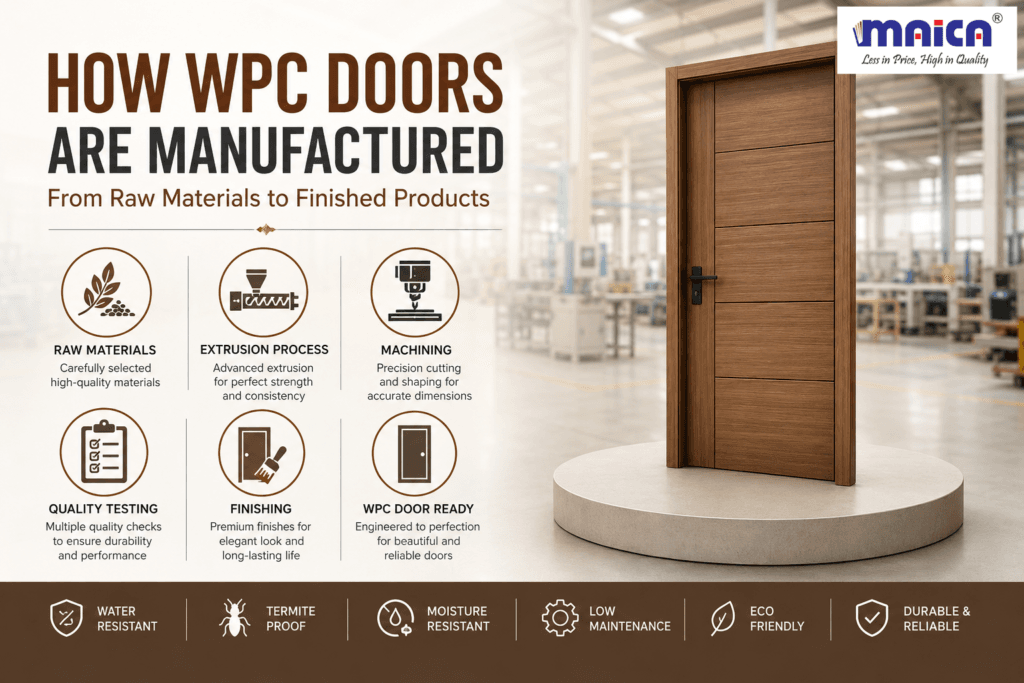
What Are WPC Doors?
WPC Doors are engineered doors manufactured from a blend of wood fibres, thermoplastic polymers, and specialised additives. Unlike solid timber doors, they are produced through a controlled manufacturing process that improves dimensional stability, moisture resistance, and long-term durability.
Unlike natural timber, WPC is an engineered composite material. Instead of depending on the natural characteristics of a single piece of wood, manufacturers create a uniform material by combining carefully measured ingredients under controlled temperature and pressure.
This engineered approach provides greater consistency in density, strength, and finish, making WPC suitable for applications where stability and durability are important.
Modern WPC Doors are widely used in:
- Residential homes
- Apartments
- Hotels
- Hospitals
- Educational institutions
- Office buildings
- Commercial projects
- Bathroom applications
- Interior partitions
When combined with WPC Door Frames, they form a complete door system designed to perform reliably in a variety of environments.
The Evolution of Wood Plastic Composite
Wood Plastic Composite was developed to combine the natural appearance of wood with the durability and moisture resistance of polymers. Over time, improvements in material science and manufacturing technology expanded its use from outdoor decking to doors, frames, wall panels, and other building products.
Composite materials have existed for decades, but early WPC formulations were primarily used in outdoor decking and landscape applications.
As extrusion technology improved, manufacturers developed formulations with better strength, improved dimensional stability, and smoother surface finishes. These advancements allowed WPC to move into interior construction products such as doors, door frames, wall panels, decorative profiles, and furniture.
Today, WPC has become an important part of modern building materials because it offers designers and builders an alternative that balances performance, aesthetics, and ease of maintenance.
Why Was WPC Developed?
Natural wood remains an attractive material, but it also presents several engineering challenges.
Depending on climate, timber can:
- Absorb moisture
- Expand and contract
- Develop cracks
- Warp over time
- Require regular polishing
- Be vulnerable to termite attack
- Vary in density and grain
Engineers sought a material that retained the appearance of wood while reducing these limitations.
The result was Wood Plastic Composite, a material designed to provide more predictable performance through controlled manufacturing rather than relying solely on natural timber characteristics.
Understanding the Science Behind WPC
WPC is not simply wood mixed with plastic.
It is an engineered composite where each ingredient performs a specific function.
The wood component contributes rigidity and a natural appearance, while the polymer acts as a binding matrix that protects the fibres and improves resistance to moisture. Additional additives enhance processing, UV stability, colour consistency, and overall performance.
The balance between these ingredients determines the final properties of the product. A well-designed formulation can improve mechanical strength, dimensional stability, and surface quality.
Raw Materials Used in WPC Manufacturing
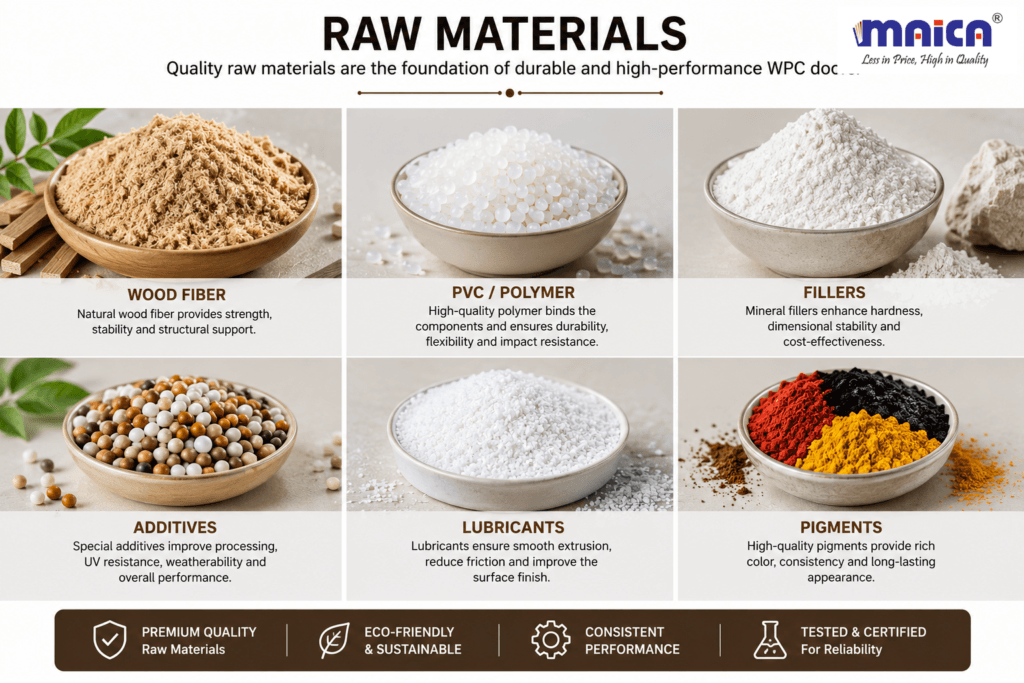
The performance of any WPC product depends largely on the quality and proportion of its raw materials.
Each ingredient serves a specific engineering purpose.
1. Wood Fibre
Wood fibre provides structural reinforcement within the composite.
It contributes to:
- Mechanical strength
- Rigidity
- Screw-holding performance
- Natural wood-like appearance
The quality, size, and moisture content of the fibres influence the consistency of the finished product.
2. Wood Flour
Wood flour consists of finely processed wood particles.
Compared with larger fibres, it improves:
- Surface smoothness
- Material consistency
- Processing efficiency
- Finishing quality
Manufacturers carefully control particle size because uneven particles can affect extrusion quality.
3. HDPE (High-Density Polyethylene)
HDPE is one of the most widely used thermoplastic polymers in WPC manufacturing.
Its main functions include:
- Binding wood particles together
- Improving moisture resistance
- Enhancing impact performance
- Increasing flexibility during processing
Its durability makes it suitable for many composite building products.
4. PVC (Polyvinyl Chloride)
Some WPC formulations use PVC instead of HDPE.
PVC-based composites generally offer:
- Higher rigidity
- Better dimensional stability
- Good surface finish
- Consistent machining characteristics
The choice between HDPE and PVC depends on the intended application and product design.
5. Calcium Carbonate
Calcium Carbonate acts as a mineral filler.
It helps:
- Improve stiffness
- Maintain dimensional stability
- Support processing efficiency
- Optimise material formulation
The amount used must be carefully controlled to maintain overall product performance.
6. UV Stabilisers
Products exposed to sunlight require protection against ultraviolet radiation.
UV stabilisers help reduce:
- Colour fading
- Surface degradation
- Long-term weathering effects
This is particularly important for applications receiving regular sunlight.
7. Lubricants
Lubricants assist material flow during extrusion.
They reduce friction between the material and the machinery, allowing smoother production and better surface quality.
8. Colour Pigments
Pigments provide the desired appearance.
Modern WPC products are available in a wide range of finishes, including:
- Natural wood shades
- Contemporary greys
- White finishes
- Walnut tones
- Teak finishes
- Decorative colours
Consistent pigmentation contributes to visual quality across production batches.
9. Processing Aids
Processing aids improve manufacturing efficiency.
They help maintain stable extrusion conditions, improve surface finish, and support consistent production quality.
Why Raw Material Quality Matters?
Every ingredient influences the finished product.
Poor-quality raw materials can result in:
- Uneven density
- Reduced screw-holding strength
- Surface defects
- Dimensional variation
- Lower durability
For this reason, experienced manufacturers invest significant effort in raw material inspection and quality control before production begins.
How Are WPC Doors Manufactured?
WPC Doors are manufactured by selecting quality raw materials, drying wood fibres, preparing a precise batch formulation, mixing the ingredients, extruding the composite through a twin screw extruder, cooling and calibrating the profile, machining it, finishing the surface, inspecting quality, and finally packaging the finished product. Each stage influences the final strength, stability, and durability of the door.
Unlike conventional wooden doors that are cut and assembled from timber, WPC products are manufactured through a controlled engineering process. Every stage is monitored to achieve consistent dimensions, surface quality, and mechanical performance.
Step 1 – Raw Material Selection
The manufacturing process begins with selecting the correct raw materials.
The quality of the finished WPC Doors depends heavily on the consistency of:
- Wood fibre
- Wood flour
- Polymer
- Fillers
- Additives
- Pigments
Even a small variation in moisture content or particle size can affect the quality of the final product.
Quality Checks
Manufacturers typically inspect:
- Moisture content
- Particle size
- Material purity
- Bulk density
- Storage conditions
Proper storage is equally important because moisture absorbed during storage can affect the extrusion process.
Step 2 – Material Drying
Wood fibres and wood flour must be dried before manufacturing because excessive moisture can create steam during extrusion, leading to poor surface finish, internal voids, and reduced product strength.
Drying is one of the most important stages in WPC manufacturing.
If the wood particles contain excessive moisture, problems may include:
- Air pockets
- Surface bubbles
- Poor bonding
- Reduced density
- Inconsistent dimensions
Industrial drying systems are used to reduce moisture to the desired level before production.
Step 3 – Batch Preparation
Once the raw materials are ready, they are measured according to a specific formulation.
Each production batch follows a predefined recipe.
The formulation determines:
- Density
- Flexural strength
- Impact resistance
- Screw-holding capacity
- Surface quality
Modern production facilities rely on precise weighing systems to minimise variation between batches.
Step 4 – High-Speed Mixing
The measured ingredients are transferred to a high-speed mixer.
Here, the components are blended until they become a uniform mixture.
The mixer distributes:
- Wood fibres
- Polymer
- Fillers
- UV stabilisers
- Pigments
- Processing aids
Uniform mixing is essential because uneven distribution can lead to inconsistent product performance.
Machinery Spotlight: High-Speed Mixer
A high-speed mixer performs two important functions:
- It disperses the ingredients evenly.
- It generates controlled heat through friction, helping prepare the material for extrusion.
A well-mixed batch contributes to smoother extrusion and a better surface finish.
Step 5 – Twin Screw Extrusion
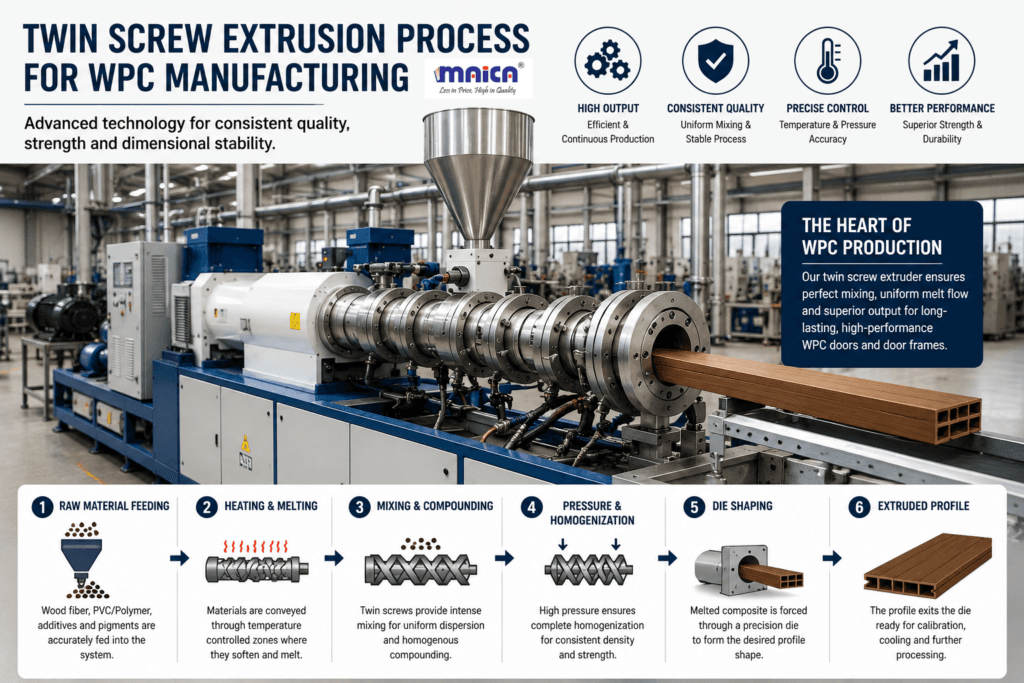
Twin screw extrusion is the core manufacturing process in which heat, pressure, and rotating screws transform the mixed raw materials into a continuous WPC profile with consistent density and shape.
The mixed material is fed into a Twin Screw Extruder.
Inside the machine:
- The material is heated.
- The polymer softens.
- Wood particles become encapsulated.
- The mixture is compressed.
- The composite becomes homogeneous.
Finally, the material is pushed through a specially designed die that gives it the required profile.
This stage largely determines the physical properties of the finished WPC product.
Why Twin Screw Extruders Are Preferred
Compared with single-screw systems, twin screw extruders provide:
- Better mixing efficiency
- Improved material dispersion
- Stable pressure
- Consistent density
- Better dimensional control
These advantages make them suitable for manufacturing high-quality WPC products.
Step 6 – Cooling
The profile leaving the extruder is still hot and relatively soft.
Cooling stabilises the material before further processing.
Cooling may be achieved through:
- Water cooling
- Air cooling
- Combination cooling systems
Proper cooling prevents distortion and helps maintain dimensional accuracy.
Step 7 – Vacuum Calibration
After cooling, the profile enters the calibration section.
Why Calibration Matters
Calibration ensures:
- Uniform thickness
- Correct width
- Straight profile
- Consistent geometry
Vacuum calibration tables use specially designed moulds to maintain the desired dimensions while the material solidifies.
Without accurate calibration, products may become:
- Warped
- Uneven
- Difficult to install
Step 8 – Surface Treatment
The next stage improves the appearance of the product.
Depending on the design, the surface may undergo:
- Sanding
- Brushing
- Embossing
- Texturing
These processes create finishes ranging from smooth contemporary surfaces to realistic wood grain patterns.
Surface treatment also prepares the product for optional decorative laminates.
Step 9 – Cutting
Once the profile reaches the required stability, it is cut to length.
Automatic cutting machines ensure:
- Square edges
- Accurate dimensions
- Consistent production
Precision is particularly important for WPC Door Frames, where even small dimensional differences can affect installation.
Step 10 – CNC Processing
Many modern WPC Doors undergo CNC machining.
Computer Numerical Control (CNC) technology enables highly accurate processing.
Typical CNC operations include:
- Lock pockets
- Handle holes
- Hinge recesses
- Decorative grooves
- Panel detailing
Because the machine follows digital designs, repeatability remains high across large production batches.
Step 11 – Lamination (Where Applicable)
Some WPC products receive decorative laminates.
Lamination serves two purposes:
Aesthetic Enhancement
It provides finishes such as:
- Walnut
- Teak
- Oak
- Ash
- White
- Contemporary matte colours
Surface Protection
It also improves resistance to:
- Minor scratches
- Everyday wear
- Surface staining
The quality of lamination depends on adhesive systems, surface preparation, and controlled application.
Step 12 – Quality Inspection
Quality inspection verifies that every WPC Door meets dimensional, visual, and mechanical requirements before packaging. Products that do not meet specifications are rejected or reprocessed.
Quality control is performed throughout production—not only at the end.
Typical inspections include:
- Dimensions
- Surface finish
- Colour consistency
- Straightness
- Edge quality
- Lamination quality
- Machining accuracy
Only products meeting internal quality standards proceed to packaging.
Step 13 – Packaging
Packaging protects finished products during storage and transportation.
Common packaging materials include:
- Protective film
- Foam edge protectors
- Corrugated cardboard
- Corner guards
- Stretch wrapping
- Wooden pallets (for bulk transport)
Proper packaging helps minimise handling damage before installation.
Step 14 – Dispatch
Before dispatch, production records are reviewed to confirm that the order specifications have been met.
Products are then prepared for transportation to distributors, project sites, or retail locations.
Traceability systems may also be used so that production batches can be identified if quality reviews are required later.
Common Manufacturing Challenges
Even with modern equipment, manufacturers must carefully manage production variables.
Some common challenges include:
- Excess moisture in raw materials
- Incorrect formulation ratios
- Temperature fluctuations
- Poor screw configuration
- Inadequate cooling
- Uneven calibration
- Surface defects
- Lamination inconsistencies
Controlling these variables is essential for producing high-quality WPC products consistently.
Why Process Control Matters
A high-quality WPC Door is not the result of a single machine.
It is the outcome of:
- Consistent raw materials
- Accurate formulations
- Well-maintained machinery
- Skilled operators
- Continuous quality monitoring
Every manufacturing stage contributes to the final performance of the product.
Machinery and Quality Testing in WPC Manufacturing
Machinery Used in Modern WPC Manufacturing
The quality of WPC Doors depends not only on raw materials but also on the precision of the machinery used during production. Every machine in the manufacturing line performs a specific task that contributes to the strength, consistency, appearance, and dimensional accuracy of the finished product.
A modern WPC manufacturing plant typically consists of an integrated production line where each machine works in sequence. Stable machine settings, regular maintenance, and accurate process control are essential to achieving consistent product quality.
High-Speed Mixer
The production process begins with the High-Speed Mixer, where all raw materials are blended into a homogeneous mixture.
Its primary responsibilities include:
- Uniform distribution of wood fibres and polymers
- Even dispersion of pigments and additives
- Controlled heating through friction
- Preparation of material for extrusion
An efficient mixing process helps eliminate material segregation and ensures that every production batch has consistent properties.
Engineering Consideration
Mixing time, blade speed, and material temperature must remain within specified limits. Excessive heat during mixing may affect the polymer, while insufficient mixing can lead to poor dispersion of additives.
Twin Screw Extruder
The Twin Screw Extruder is considered the heart of the WPC manufacturing process.
It performs several operations simultaneously:
- Heating
- Melting
- Mixing
- Compressing
- Conveying
- Shaping
Inside the barrel, two rotating screws move the material through different temperature zones until it becomes a uniform composite ready for forming.
Why Twin Screw Technology?
Twin screw systems provide:
- Better material dispersion
- Improved temperature control
- Stable pressure
- Consistent density
- Reduced material variation
These advantages are especially important when manufacturing WPC Doors and WPC Door Frames, where dimensional accuracy and structural integrity are essential.
Vacuum Calibration Table
Immediately after extrusion, the hot profile enters the vacuum calibration section.
The calibration table helps maintain:
- Width
- Thickness
- Straightness
- Surface geometry
Vacuum pressure gently holds the profile against calibration moulds while cooling begins.
Without proper calibration, finished products may show:
- Bowing
- Twisting
- Uneven thickness
- Poor fitting during installation
Cooling Tank
After calibration, the profile continues through the cooling system.
Cooling is carefully controlled because rapid or uneven cooling may create internal stresses within the material.
Typical cooling methods include:
- Water immersion
- Water spray
- Air-assisted cooling
The objective is to stabilise the profile without affecting its dimensional accuracy.
Haul-Off Machine
The haul-off machine pulls the profile through the production line at a controlled speed.
This speed must match the extrusion rate precisely.
If the haul-off speed is too fast, the profile may stretch. If it is too slow, deformation may occur.
Maintaining synchronisation between extrusion and haul-off is one of the most important aspects of process control.
Automatic Cutting Machine
Once the profile reaches the required length, it is cut automatically.
Modern cutting systems provide:
- Accurate length
- Clean edges
- Square cuts
- High production efficiency
Automation also reduces human error and improves repeatability.
CNC Router
For products requiring machining, the next stage involves CNC processing.
A CNC Router can produce:
- Lock pockets
- Hinge recesses
- Handle holes
- Decorative grooves
- Panel profiles
- Custom machining
Computer-controlled machining provides repeatable accuracy across large production batches.
Lamination Machine
Many decorative WPC products receive laminated finishes.
The lamination process requires:
- Proper adhesive application
- Uniform pressure
- Controlled temperature
- Dust-free surfaces
A correctly laminated surface improves both appearance and resistance to everyday wear.
Dust Collection System
Although often overlooked, dust collection is an important part of a modern manufacturing facility.
It helps:
- Improve workplace safety
- Maintain machine performance
- Reduce airborne dust
- Protect finished surfaces
- Improve production cleanliness
A clean production environment contributes to more consistent product quality.
Why Quality Testing Is Essential
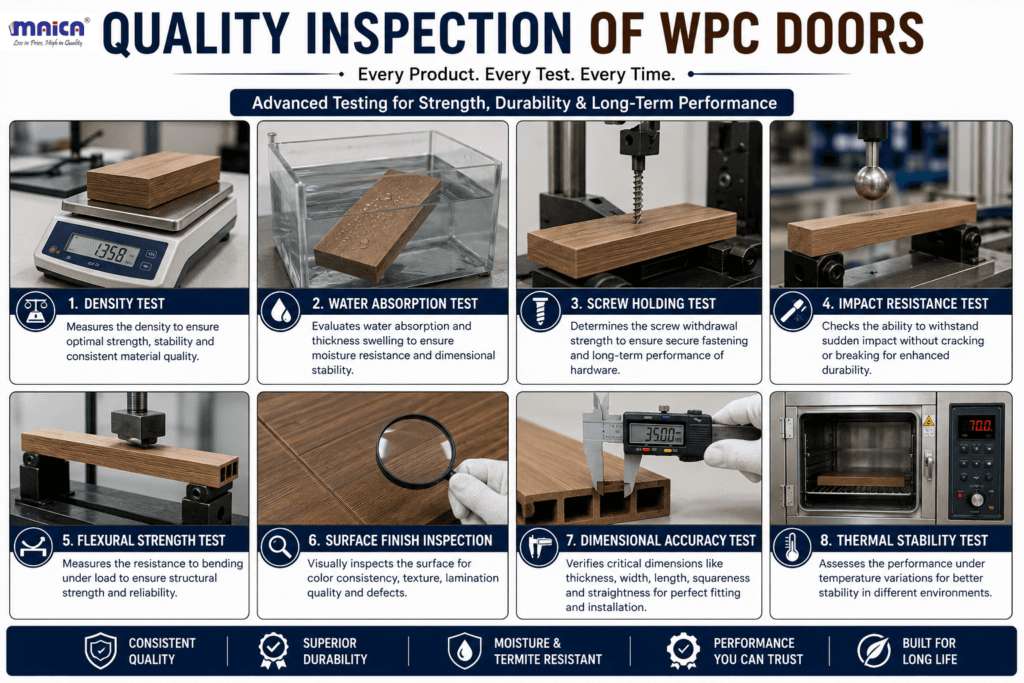
Quality testing ensures that WPC products meet predefined performance standards before they reach customers. By evaluating mechanical strength, dimensional stability, moisture resistance, and surface quality, manufacturers can identify defects early and maintain consistent product performance.
Quality inspection is not limited to the final stage of production.
Instead, testing begins with raw materials and continues throughout the manufacturing process.
Density Test
Density is one of the most important physical properties of WPC.
It influences:
- Structural strength
- Screw holding capacity
- Weight
- Machining performance
- Overall durability
Density is typically measured by comparing the weight of a sample with its volume.
Why It Matters
Products with inconsistent density may experience:
- Weak areas
- Poor machining
- Reduced mechanical strength
- Variable performance
Maintaining uniform density improves consistency throughout the production batch.
Water Absorption Test
One of the recognised advantages of WPC is its improved resistance to moisture compared with many traditional wood products.
The Water Absorption Test evaluates how much moisture a material absorbs over a specified period.
The procedure generally involves:
- Recording the sample weight.
- Immersing the sample in water for a defined duration.
- Measuring any increase in weight.
- Assessing dimensional changes.
Lower water absorption generally indicates better resistance to swelling and deformation.
Screw Holding Test
Doors and frames rely on hinges, locks, and handles.
These components remain secure only if the material provides adequate screw holding strength.
During testing, a screw is inserted into the sample and subjected to a controlled pulling force.
The recorded value indicates how effectively the material retains fasteners.
Practical Importance
Strong screw holding improves:
- Hinge performance
- Lock stability
- Door alignment
- Long-term reliability
Impact Resistance Test
Doors are exposed to repeated impacts during daily use.
The Impact Resistance Test evaluates the material’s ability to absorb sudden loads without cracking or breaking.
Samples are subjected to controlled impact energy, and the resulting damage is carefully assessed.
Products with good impact resistance are better suited to high-traffic environments such as schools, hospitals, offices, and commercial buildings.
Flexural Strength Test
Flexural strength measures the material’s resistance to bending under load.
During testing, the sample is supported at both ends while a force is applied at the centre.
This test helps determine:
- Structural rigidity
- Load-bearing capability
- Overall mechanical performance
Higher flexural strength contributes to improved stability during long-term use.
Surface Finish Inspection
A technically sound product should also achieve a high visual standard.
Inspectors evaluate:
- Colour consistency
- Texture
- Lamination quality
- Scratches
- Surface defects
- Machining marks
Even minor visual imperfections may affect customer satisfaction, making this inspection an important part of quality assurance.
Dimensional Accuracy Test
Accurate dimensions are critical for installation.
Measurements are taken using precision instruments to verify:
- Height
- Width
- Thickness
- Squareness
- Straightness
Maintaining tight manufacturing tolerances reduces installation issues on site.
Why Continuous Quality Control Matters
Modern WPC manufacturing relies on continuous monitoring rather than final inspection alone.
By checking materials, machinery, and finished products throughout production, manufacturers can:
- Reduce waste
- Improve consistency
- Detect defects early
- Increase manufacturing efficiency
- Deliver reliable product quality
For products such as WPC Doors and WPC Door Frames, this systematic approach helps ensure that every batch meets the required engineering and quality standards.
Where Are WPC Products Used?
WPC products are widely used in residential, commercial and institutional buildings because they combine durability, moisture resistance and design flexibility. Their versatility allows them to be used for doors, door frames, wall panels, furniture, decking and several other interior and exterior applications.
As manufacturing technology has improved, Wood Plastic Composite has evolved from a niche material into one that is used across multiple construction sectors. Today, architects, builders and interior designers specify WPC products for projects where durability and consistent performance are important.
WPC Doors
Among all WPC products, WPC Doors are the most recognised application.
Unlike conventional timber doors, engineered WPC doors are manufactured with controlled density and consistent dimensions. This allows them to deliver predictable performance across different climatic conditions.
Typical applications include:
- Residential homes
- Luxury villas
- Apartments
- Commercial buildings
- Healthcare facilities
- Educational institutions
- Hospitality projects
The choice of design, thickness, finish and hardware depends on the intended application.
WPC Door Frames
A door performs best when paired with a compatible frame.
WPC Door Frames are engineered to provide dimensional stability and reliable support for door hardware.
They are commonly selected for:
- Bathrooms
- Bedrooms
- Kitchens
- Hotels
- Offices
- Hospitals
- Apartment projects
Accurate machining also allows easier installation of hinges, locks and accessories.
Bathroom Doors
Bathrooms are exposed to high humidity throughout the year.
For this reason, materials with improved moisture resistance are often preferred over conventional untreated timber in these environments.
When selecting a bathroom door, important considerations include:
- Moisture exposure
- Ventilation
- Hardware compatibility
- Ease of cleaning
- Long-term dimensional stability
Bedroom Doors
Bedroom doors are generally chosen for:
- Privacy
- Appearance
- Acoustic comfort
- Interior aesthetics
The finish often plays a significant role in matching the interior design theme.
Kitchen Doors
Kitchen environments expose doors to:
- Steam
- Temperature variation
- Daily cleaning
- Frequent usage
Selecting a suitable material helps maintain both appearance and functionality over time.
Commercial Buildings
Commercial projects demand materials capable of handling continuous use.
Examples include:
- Office buildings
- Shopping centres
- Retail outlets
- Business parks
High-traffic areas require products with good dimensional stability and reliable hardware performance.
Hotels
Hotel doors experience repeated opening and closing every day.
Project specifications often focus on:
- Appearance
- Uniform finish
- Ease of maintenance
- Long service life
Consistency across hundreds of doors is particularly important in hospitality projects.
Hospitals
Healthcare facilities require doors that are easy to maintain and suitable for demanding environments.
Material selection may consider:
- Frequent cleaning
- Surface hygiene
- Reliability
- Long-term durability
Schools and Educational Institutions
Educational buildings experience continuous daily use.
Doors installed in schools should provide:
- Good impact resistance
- Reliable hardware performance
- Low maintenance
- Consistent operation
Offices
Office interiors increasingly favour modern materials that combine durability with contemporary aesthetics.
Door systems are selected based on:
- Interior design
- Functionality
- Maintenance requirements
- Long-term operational performance
Wall Panels
Beyond doors, WPC is also used for decorative wall panelling.
Wall panels are popular in:
- Living rooms
- Reception areas
- Hotels
- Corporate offices
- Retail interiors
The variety of textures and finishes allows designers to create different architectural styles.
Outdoor Applications
Certain WPC formulations are suitable for exterior applications such as:
- Decking
- Pergolas
- Garden seating
- Landscape structures
- Cladding
Outdoor applications require formulations designed to withstand changing weather conditions and UV exposure.
Furniture
WPC can also be used in selected furniture applications where dimensional stability and ease of maintenance are desirable.
Examples include:
- Cabinets
- Storage units
- Shelving
- Decorative furniture
- Utility furniture
Suitability depends on product design and intended use.
WPC vs Wood vs PVC
Choosing the right material requires understanding the strengths and limitations of each option.
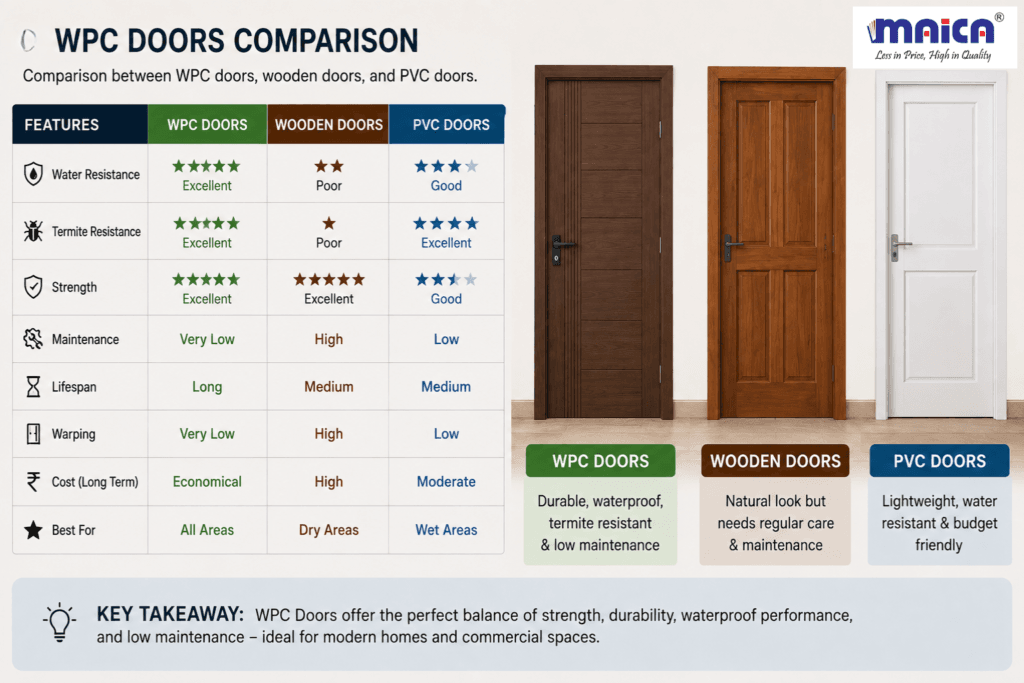
| Parameter | WPC | Natural Wood | PVC |
| Initial Cost | Medium | Medium to High | Low to Medium |
| Lifetime Value | High | Depends on Maintenance | Moderate |
| Water Resistance | Excellent | Moderate to Low | Excellent |
| Termite Resistance | High | Requires Treatment | High |
| Maintenance | Low | High | Low |
| Dimensional Stability | High | Can Expand or Shrink | Good |
| Surface Finish | Consistent | Natural Grain | Uniform |
| Screw Holding | Good (depends on formulation) | Excellent | Moderate |
| Appearance | Wood-like | Natural Timber | Modern Synthetic |
| Sustainability | Can incorporate recycled materials | Depends on timber source | Depends on polymer source |
| Installation | Straightforward | Standard | Standard |
| Typical Applications | Residential & Commercial | Premium Interiors | Utility Areas |
No single material is ideal for every project. The most suitable choice depends on design requirements, environmental conditions, expected usage and maintenance preferences.
Buyer’s Guide: How to Choose Quality WPC Doors
When selecting WPC Doors, buyers should evaluate material density, manufacturing quality, thickness, surface finish, hardware compatibility, frame quality and installation standards rather than focusing on price alone.
A well-informed purchase begins with understanding the technical characteristics of the product.
1. Check Material Density
Density influences:
- Structural strength
- Stability
- Screw-holding performance
- Machining quality
Ask for technical specifications where available.
2. Select the Correct Thickness
Different projects require different door thicknesses.
Common considerations include:
- Residential use
- Commercial use
- Interior applications
- Heavy-duty installations
The appropriate thickness should match the intended application and hardware.
3. Evaluate Surface Finish
Inspect the finish for:
- Colour consistency
- Smoothness
- Lamination quality
- Edge finishing
- Uniform texture
A high-quality finish contributes to both appearance and long-term durability.
4. Consider Hardware Compatibility
A door should work effectively with:
- Hinges
- Locks
- Handles
- Door closers
- Door stoppers
Compatibility between the door, frame and hardware is essential for reliable performance.
5. Inspect the Door Frame
Even a well-manufactured door may not perform properly if paired with an unsuitable frame.
Check:
- Straightness
- Joint quality
- Dimensional accuracy
- Machining precision
6. Assess Manufacturing Quality
Rather than relying solely on product appearance, consider whether the manufacturer follows structured quality control procedures throughout production.
Consistency in manufacturing often has a greater impact on long-term performance than cosmetic appearance alone.
Maintenance Guide
One reason WPC has become increasingly popular is its relatively simple maintenance.
Routine care can help preserve appearance and functionality for many years.
Cleaning
Regular cleaning removes dust and everyday dirt.
Use:
- A soft cloth
- Mild detergent
- Clean water
Avoid harsh chemicals unless recommended for the specific finish.
Hardware Care
Periodically inspect:
- Hinges
- Locks
- Handles
- Fasteners
Tightening loose hardware can help maintain smooth operation.
Surface Care
Avoid dragging sharp objects across the surface.
Where decorative laminates are used, follow the manufacturer’s cleaning recommendations to preserve the finish.
Periodic Inspection
Check for:
- Loose hardware
- Surface damage
- Seal integrity
- Installation alignment
Early attention to minor issues can prevent more significant maintenance later.
Common Myths About WPC
Myth 1: WPC Is Just Plastic
WPC is a composite material that combines wood fibres with polymers and performance-enhancing additives. Its properties differ significantly from conventional plastic products.
Myth 2: Every WPC Product Has the Same Quality
Manufacturing technology, raw material selection, formulation and quality control all influence the final product. As a result, performance can vary between manufacturers and product ranges.
Myth 3: WPC Cannot Be Used Outdoors
Some formulations are specifically engineered for outdoor applications such as decking, pergolas and cladding. Suitability depends on the product specification and intended environment.
Myth 4: WPC Requires No Maintenance
Although maintenance requirements are generally lower than those of many traditional materials, regular cleaning and periodic inspection are still recommended.
Myth 5: Appearance Is the Only Factor That Matters
A visually attractive door should also meet technical requirements such as dimensional stability, hardware compatibility and manufacturing quality.
The Future of WPC in Sustainable Construction
Why WPC Is Becoming More Important
As the construction industry moves towards durable, resource-efficient and low-maintenance materials, WPC is expected to play a growing role. Advances in manufacturing, recycling technologies and engineered composites continue to improve the performance and application range of WPC products.
Modern construction increasingly focuses on materials that combine longevity with efficient use of resources. Rather than relying solely on traditional materials, architects and engineers are evaluating products that offer consistent performance throughout their service life.
Future developments in WPC manufacturing are expected to focus on:
- Improved polymer formulations
- Greater use of recycled materials
- Enhanced surface finishes
- Better UV stability
- Improved fire-performance formulations
- Higher machining precision
- Smarter manufacturing automation
As manufacturing technology evolves, WPC products are likely to become suitable for an even wider range of architectural and commercial applications.
Why Trust Maica Group’s Manufacturing Expertise?
Selecting a WPC product involves more than comparing designs or finishes. Manufacturing quality, process control and engineering standards play a significant role in long-term performance.
At Maica Plastiwood Pvt. Ltd., the WPC door manufacturing philosophy is centred on consistency, quality control and continuous product improvement.
The production process focuses on:
- Careful raw material selection
- Controlled manufacturing processes
- Modern production machinery
- Precision machining
- Consistent quality inspection
- Reliable product finishing
Rather than relying on marketing claims, Maica Group places emphasis on engineering principles and manufacturing discipline to produce WPC Doors and WPC Door Frames suitable for modern construction projects.
Continuous investment in manufacturing knowledge and quality processes helps ensure products meet the practical expectations of architects, builders, contractors and homeowners.
Frequently Asked Questions
1. What are WPC Doors made from?
WPC Doors are manufactured using a combination of wood fibres or wood flour, thermoplastic polymers and specialised additives. These materials are processed together to create a composite with consistent physical properties.
2. Are WPC Doors suitable for bathrooms?
Yes. WPC Doors are widely used in bathrooms because they generally offer better resistance to moisture than conventional untreated timber. Product suitability should always be confirmed according to the manufacturer’s specifications.
3. Can WPC Doors be used in commercial buildings?
Yes. WPC Doors are commonly specified for offices, hotels, hospitals, schools and other commercial projects where durability and ease of maintenance are important.
4. How long do WPC Doors last?
The service life depends on WPC door manufacturing quality, installation, usage and maintenance. Properly manufactured and correctly installed WPC Doors are designed for long-term performance.
5. Do WPC Doors require painting?
Many WPC Doors are supplied with finished surfaces that do not require painting. If painting or refinishing is desired, compatibility with the specific product should be verified.
6. Are WPC Door Frames better than wooden frames?
Each material has its advantages. WPC Door Frames are often selected where dimensional stability and resistance to moisture are important considerations.
7. What affects the quality of a WPC Door?
Important factors include:
- Raw material quality
- Manufacturing formulation
- Extrusion process
- Density
- Surface finish
- Quality control
- Installation
8. Why is density important?
Density influences strength, machining quality, screw-holding capability and overall product consistency.
9. Can WPC products be machined using CNC equipment?
Yes. WPC materials are commonly machined using CNC equipment for lock pockets, hinge recesses, decorative patterns, and custom designs.
10. Are all WPC products identical?
No. Material composition, manufacturing technology and quality control practices differ between manufacturers, resulting in varying product performance.
11. Can WPC Doors support standard hardware?
Yes. Most WPC Doors are designed to accommodate commonly used hinges, locks and handles, provided they are installed according to the manufacturer’s recommendations.
12. Is WPC environmentally responsible?
Many WPC products incorporate recycled or resource-efficient materials. The overall environmental impact depends on raw material sourcing, manufacturing methods and product lifecycle.
13. What maintenance do WPC Doors require?
Routine cleaning with a soft cloth, periodic inspection of hardware and following the manufacturer’s care instructions are generally sufficient for normal use.
14. Can WPC Doors be customised?
Yes. Depending on the manufacturing process, WPC Doors can be produced in a range of sizes, surface finishes, decorative patterns and machining configurations.
15. Why should buyers understand the manufacturing process?
Understanding how WPC products are manufactured helps buyers evaluate product quality beyond appearance. Knowledge of materials, machinery and testing methods enables better purchasing decisions.
Summary
Wood Plastic Composite represents a significant advancement in modern building materials. By combining wood fibres, thermoplastic polymers and engineered additives through a carefully controlled manufacturing process, WPC products achieve consistent quality and dependable performance across a wide range of applications.
From raw material selection and precision extrusion to CNC machining, surface finishing and comprehensive quality testing, every stage of production contributes to the final characteristics of a WPC Door or WPC Door Frame. Understanding these processes enables homeowners, architects, contractors and building professionals to make informed decisions based on engineering principles rather than appearance alone.
As sustainable construction practices continue to evolve, WPC is expected to remain an important material for residential and commercial projects where durability, dimensional stability and low maintenance are valued.
Understanding how WPC products are manufactured is an important step in selecting the right material for any project. To explore WPC Doors, WPC Door Frames, or learn more about WPC door manufacturing standards and available product options, browse the technical resources and product information from Maica Group to make an informed decision.
Follow us on Facebook for new updates or contact us.