
Choosing the right door is more important than most people realize. A door is not just an entry point—it affects durability, maintenance costs, security, aesthetics, and the long-term value of your property.
Many Indian homeowners and building material dealers still prefer traditional wooden doors because they have been used for decades. However, wooden doors often develop problems such as swelling during monsoon, termite attacks, moisture damage, warping, and frequent maintenance. These issues increase ownership costs over time.
This is where WPC Doors have emerged as a practical and reliable alternative. Designed to withstand India’s diverse climate conditions, WPC doors offer excellent durability, water resistance, termite protection, and long service life with minimal maintenance.
Whether you are constructing a new home, renovating an apartment, developing commercial spaces, or expanding your dealership portfolio, understanding WPC doors can help you make an informed investment.
This comprehensive guide explains everything you need to know—from manufacturing and material composition to technical specifications, buying tips, installation guidance, and maintenance.
What Are WPC Doors?
WPC (Wood Plastic Composite) Doors are engineered doors manufactured using a combination of carefully processed wood fibers, thermoplastics, additives, and performance-enhancing compounds. The materials are blended under controlled conditions and extruded or molded into solid, high-density door panels.
Unlike conventional wooden doors, WPC doors are manufactured rather than carved from natural timber. This engineering process ensures consistent density, dimensional stability, and improved resistance to environmental factors.
A quality WPC door typically contains:
- Premium wood flour or wood fibers
- Virgin polymer compounds
- Mineral fillers
- UV stabilizers
- Heat stabilizers
- Impact modifiers
- Moisture-resistant additives
- Color pigments
The exact composition varies depending on the manufacturer and intended application.
The result is a door that combines the natural appearance of wood with the durability of engineered materials.
Why WPC Doors Are Becoming Popular in India
The Indian construction industry has witnessed a significant shift toward engineered building materials over the last few years. Architects, builders, interior designers, and homeowners increasingly prefer WPC because it addresses common problems associated with wooden doors.
Several factors contribute to this growing demand:
- Increasing awareness about waterproof building materials
- Rising timber prices
- Demand for low-maintenance products
- Better resistance to termites
- Longer product lifespan
- Sustainable manufacturing practices
- Modern interior design preferences
Government infrastructure projects, residential developments, hospitals, educational institutions, hotels, and commercial complexes are also adopting WPC products because they reduce maintenance expenses throughout the building’s life-cycle.
What Are WPC Doors Made Of?
One of the biggest advantages of WPC doors is their engineered construction.
Instead of relying entirely on natural wood, manufacturers combine multiple raw materials to achieve superior mechanical performance.
Wood Fibers
Wood fibers provide structural strength and help create the natural texture associated with wooden products.
High-quality wood flour also improves screw holding capacity and enhances overall rigidity.
Thermoplastic Polymer
The polymer component binds the wood particles together.
It provides flexibility, moisture resistance, and dimensional stability while reducing the chances of cracking or splitting.
Performance Additives
Special additives improve several properties:
- UV resistance
- Fire-retardant performance (depending on grade)
- Weather resistance
- Surface finish
- Manufacturing consistency
These additives help WPC doors perform effectively in different climatic conditions.
Key Features of WPC Doors
1. 100% Waterproof
Unlike wooden doors, WPC doors do not absorb water.
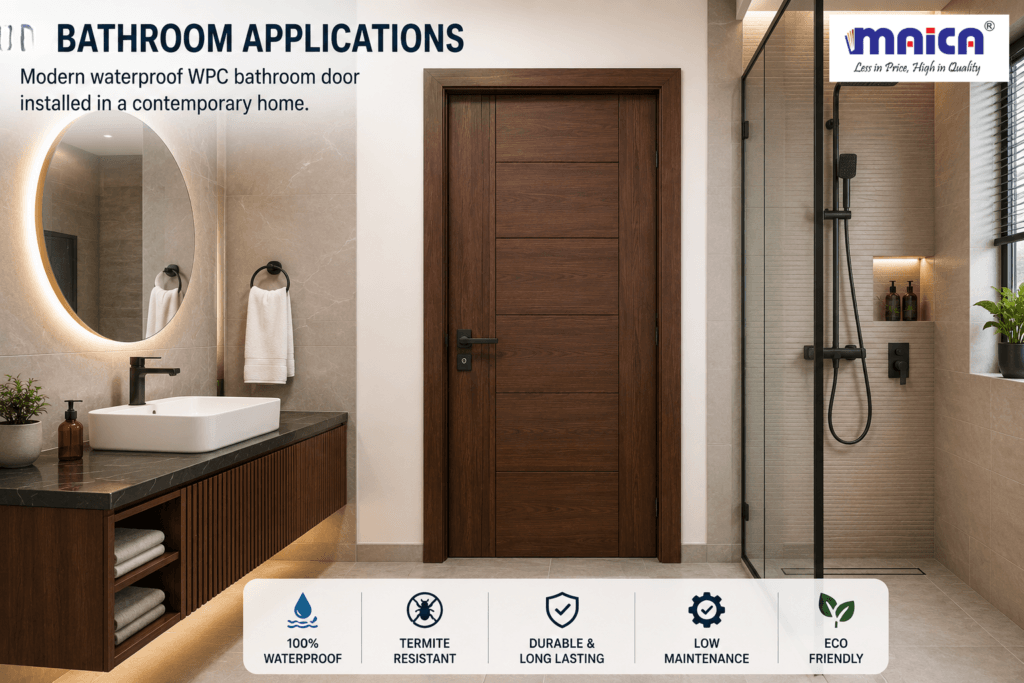
They remain stable even in areas with high humidity, making them suitable for bathrooms, kitchens, utility areas, hospitals, and coastal regions.
2. Termite Resistant
One of the biggest concerns with wooden doors is termite infestation.
Since WPC contains engineered composite materials instead of solid timber, termites cannot damage the door in the same way they attack natural wood.
3. Warp Resistant
Temperature fluctuations often cause wooden doors to bend or twist.
High-quality WPC doors maintain dimensional stability and reduce the risk of warping under normal operating conditions.
4. High Strength
Premium WPC doors are manufactured using high-density material, making them suitable for both residential and commercial applications.
They provide excellent screw holding capacity and support a wide range of premium hardware.
5. Eco-Friendly
WPC products reduce dependence on natural timber.
Many manufacturers also incorporate recycled materials into the production process, supporting more sustainable construction practices.
6. Low Maintenance
Unlike wooden doors, WPC doors do not require frequent polishing or anti-termite treatments.
Routine cleaning with a soft cloth and mild detergent is generally sufficient.
7. Attractive Designs
Modern WPC doors are available in:
- CNC designs
- Digital printed finishes
- Wooden textures
- Laminated finishes
- Decorative mouldings
- Premium matte surfaces
- Contemporary minimalist styles
This makes them suitable for both traditional and modern interiors.
Advantages of WPC Doors Over Traditional Wooden Doors
Homeowners often assume that natural wood is always superior. However, when evaluated over the entire life-cycle of a building, WPC doors offer several practical advantages.
Better Moisture Performance
Wood naturally expands and contracts as moisture levels change.
WPC maintains far greater dimensional stability.
Reduced Maintenance Cost
Wood requires regular polishing, painting, termite treatment, and repairs.
WPC significantly reduces these recurring expenses.
Longer Service Life
When manufactured using quality raw materials and installed correctly, WPC doors can provide reliable performance for many years with minimal maintenance.
Consistent Quality
Because WPC is factory-engineered, every door maintains uniform thickness, density, and finish.
Natural timber often varies in grain, moisture content, and structural consistency.
Where Can WPC Doors Be Used?
The versatility of WPC doors makes them suitable for a wide range of applications.
Residential Applications
- Main entrance (selected grades)
- Bedroom doors
- Living room doors
- Kitchen doors
- Bathroom doors
- Balcony access
- Utility rooms
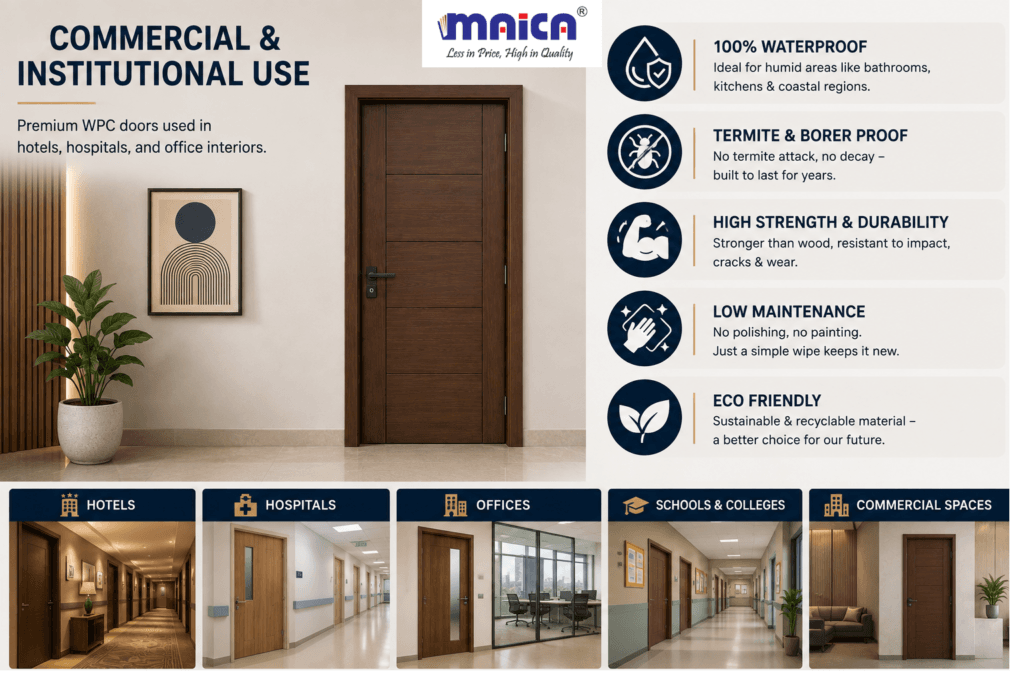
Commercial Applications
- Office cabins
- Hospitals
- Hotels
- Educational institutions
- Retail outlets
- Shopping complexes
- Restaurants
- Healthcare facilities
Industrial Applications
- Administrative buildings
- Staff accommodation
- Laboratories
- Clean utility spaces
- Factory offices
Why WPC Door Frames Are Equally Important
Installing a high-quality door with a poor-quality frame reduces overall performance.
WPC Door Frames offer several advantages over conventional wooden frames:
- Waterproof construction
- Excellent dimensional stability
- Strong screw holding
- Termite resistance
- Uniform finish
- Long service life
- Minimal maintenance
Using compatible WPC door frames also improves alignment, durability, and overall installation quality.
Common Myths About WPC Doors
Myth 1: WPC Doors Look Artificial
Modern manufacturing technology offers realistic wood grain textures, decorative laminates, and premium surface finishes that closely resemble natural wood.
Myth 2: WPC Doors Are Weak
High-density WPC doors are engineered for structural strength and are capable of supporting premium locks, hinges, and hardware when installed correctly.
Myth 3: WPC Doors Are Only for Bathrooms
While bathroom doors are one of the most popular applications due to their water resistance, WPC doors are equally suitable for bedrooms, offices, hotels, hospitals, educational institutions, and commercial spaces.
Myth 4: All WPC Doors Are the Same
Material quality, density, manufacturing process, polymer composition, raw materials, and quality control standards vary significantly between manufacturers.
Choosing a trusted manufacturer is essential for long-term performance.
Technical Specifications of High-Quality WPC Doors
When selecting WPC Doors, appearance should never be the only deciding factor. The technical specifications determine the door’s strength, durability, and long-term performance.
Although specifications vary by manufacturer, a premium WPC door generally offers the following characteristics:
| Specification | Recommended Standard |
|---|---|
| Door Thickness | 5mm, 6mm, 12mm, 18mm, 24mm, 28mm, 30mm, 35mm. |
| Standard Width | (custom sizes available) |
| Standard Height | (custom sizes available) |
| Density | High-density engineered composite |
| Water Absorption | no |
| Surface Finish | Plain, Skin, Laminated, Digital Print, CNC |
| Screw Holding | Excellent |
| Termite Resistance | Yes |
| Moisture Resistance | Excellent |
| Maintenance | Minimal |
Expert Tip: Higher density generally improves screw-holding capacity, dimensional stability, and impact resistance.
How WPC Doors Perform in Indian Weather
India experiences a wide range of climatic conditions—from humid coastal regions to dry deserts and heavy monsoon zones.
A quality WPC door is designed to perform consistently in these environments.
During Monsoon
Traditional wooden doors often absorb moisture, swell, and become difficult to close.
WPC doors remain dimensionally stable because they absorb very little water.
In High Humidity Areas
Bathrooms, kitchens, utility rooms, and coastal locations expose doors to continuous moisture.
Unlike natural timber, WPC maintains its shape and finish with minimal maintenance.
During Summer
High temperatures can affect many building materials.
Engineered WPC doors are manufactured to minimize expansion and contraction under normal service conditions.
Termite-Prone Regions
Wooden doors require regular chemical treatments.
WPC doors naturally offer much better resistance against termite attacks, reducing maintenance costs.
WPC Doors vs Wooden Doors vs PVC Doors
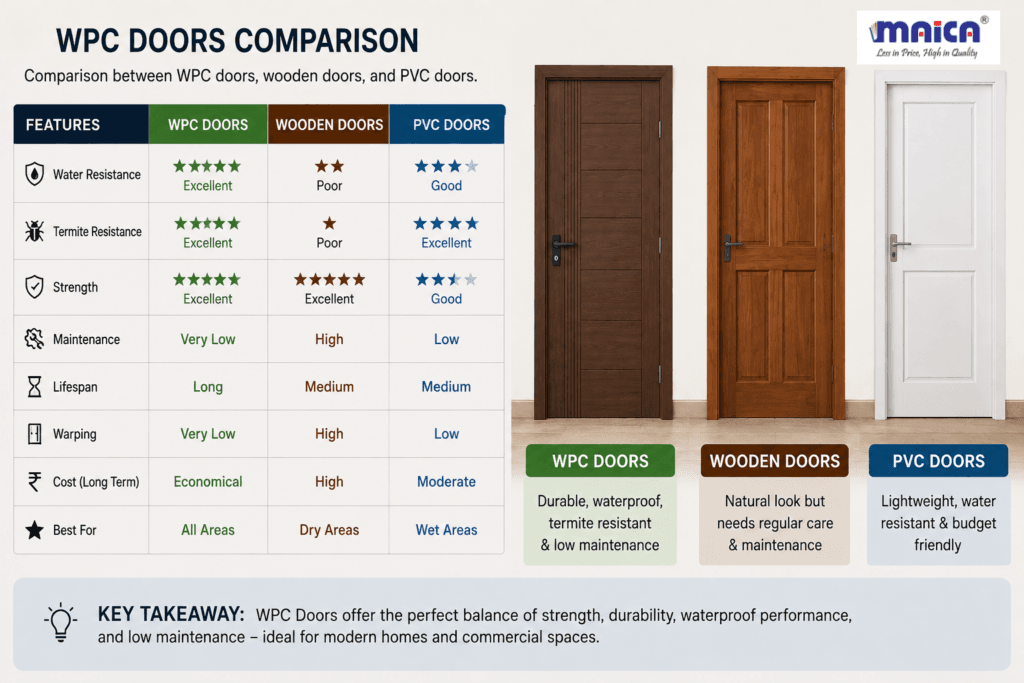
Choosing the right material becomes easier when you compare them side by side.
| Feature | WPC Doors | Wooden Doors | PVC Doors |
| Water Resistance | ⭐⭐⭐⭐⭐ | ⭐⭐ | ⭐⭐⭐⭐ |
| Termite Resistance | ⭐⭐⭐⭐⭐ | ⭐ | ⭐⭐⭐⭐⭐ |
| Strength | ⭐⭐⭐⭐⭐ | ⭐⭐⭐⭐⭐ | ⭐⭐⭐ |
| Maintenance | Very Low | High | Low |
| Lifespan | Long | Medium (depends on maintenance) | Medium |
| Painting Required | No | Yes | No |
| Warping | Very Low | Common in humid areas | Low |
| Screw Holding | Excellent | Excellent | Moderate |
| Premium Appearance | Excellent | Excellent | Moderate |
| Bathroom Use | Excellent | Not Recommended | Good |
| Cost Over Lifetime | Economical | Higher | Moderate |
Key Takeaway
- Choose Wooden Doors if natural timber aesthetics are your only priority and you are prepared for regular maintenance.
- Choose PVC Doors when budget is the primary concern.
- Choose WPC Doors if you want the best balance of durability, aesthetics, moisture resistance, and long-term value.
Why Homeowners Prefer WPC Doors
Modern homeowners want products that reduce maintenance while maintaining a premium appearance.
The most common reasons homeowners switch to WPC include:
- No termite worries
- Suitable for bathrooms and kitchens
- Easy to clean
- Long-lasting finish
- Attractive designs
- Better value over the product’s lifetime
- Available in modern colours and textures
Why Building Material Dealers Prefer WPC Doors
Demand for WPC products has increased rapidly across India.
Dealers benefit because:
- Growing consumer awareness
- Lower complaint rates
- Attractive profit margins
- Multiple design options
- Suitable for residential and commercial customers
- Easy inventory management with standard sizes
Adding quality WPC products to a dealership portfolio can help attract architects, builders, contractors, and interior designers looking for modern alternatives to traditional timber.
Complete Buyer’s Guide for WPC Doors
Before purchasing, evaluate these important factors.
1. Check the Door Density
Density directly influences strength.
A high-density door generally offers:
- Better screw holding
- Higher impact resistance
- Improved dimensional stability
- Longer lifespan
Avoid selecting a door based solely on price.
2. Examine the Surface Finish
Premium WPC doors are available in:
- Plain Finish
- Skin Finish
- Laminated Finish
- Decorative CNC Finish
- Digital Printed Finish
- Wood Texture Finish
Choose a finish that matches the overall interior design.
3. Select the Right Thickness
Different applications require different thicknesses.
For example:
- Interior Bedrooms
- Bathrooms
- Offices
- Hotels
- Commercial Buildings
Always choose a thickness recommended by the manufacturer for the intended application.
4. Evaluate the Door Frame
Many buyers focus only on the shutter.
However, WPC Door Frames play an equally important role.
A poor-quality frame can reduce alignment, durability, and hardware performance.
Whenever possible, use compatible WPC frames designed for the same system.
5. Hardware Compatibility
Premium WPC doors support:
- Mortise Locks
- Cylindrical Locks
- Digital Locks (where suitable)
- Tower Bolts
- Premium Hinges
- Door Closers
- Handles
- Door Stoppers
Always use high-quality hardware to maximize performance.
6. Manufacturer Reputation
Before purchasing, verify:
- Manufacturing capability
- Quality control process
- Product consistency
- Warranty terms
- Customer support
- Dealer network
Choosing an experienced manufacturer often results in better product consistency and after-sales service.
Step-by-Step Installation Guide
Correct installation is just as important as selecting a quality door.
Step 1
Check the wall opening.
Ensure it is level, square, and structurally sound.
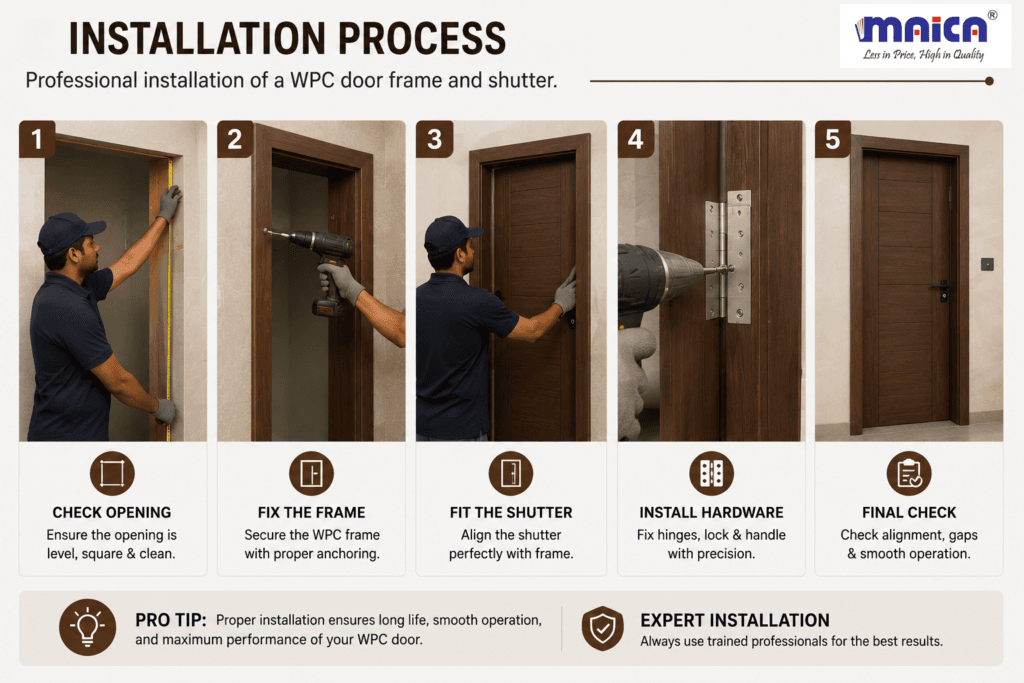
Step 2
Install the frame securely.
Proper anchoring improves long-term stability.
Step 3
Verify alignment.
Maintain uniform gaps around the shutter.
Step 4
Install hinges accurately.
Improper hinge positioning can affect door movement and hardware life.
Step 5
Fit locks and handles.
Use recommended cutting tools and avoid excessive material removal.
Step 6
Perform final adjustments.
Check:
- Smooth opening
- Proper closing
- Lock operation
- Frame alignment
- Hardware tightening
Best Applications for WPC Doors
Thanks to their moisture resistance and durability, WPC doors are suitable for a wide range of spaces.
Residential
- Bedrooms
- Living Rooms
- Kitchens
- Utility Areas
- Bathroom Doors
- Balconies
Commercial
- Offices
- Hotels
- Hospitals
- Schools
- Colleges
- Retail Stores
- Restaurants
- Clinics
Institutional
- Government Buildings
- Educational Campuses
- Healthcare Facilities
- Public Infrastructure Projects
Common Mistakes Buyers Should Avoid
Many buyers make purchasing decisions based only on price.
Instead, consider the total cost of ownership.
Avoid these common mistakes:
- Buying only on the lowest price
- Ignoring density
- Choosing an unsuitable thickness
- Using poor-quality hardware
- Installing with an inferior frame
- Hiring inexperienced installers
- Skipping maintenance instructions
A well-manufactured WPC door combined with proper installation delivers significantly better long-term performance.
Maintenance Guide for WPC Doors
One of the biggest advantages of WPC Doors is that they require very little maintenance compared to traditional wooden doors. Proper care helps preserve their appearance and ensures smooth operation for years.
Regular Cleaning
- Wipe the surface with a soft microfiber cloth.
- Use a mild soap solution for stubborn dirt.
- Dry the surface after cleaning to maintain the finish.
Avoid using abrasive scrubbers or harsh chemicals, as they may affect decorative laminates or printed finishes.
Hardware Inspection
Every 6–12 months:
- Tighten loose screws.
- Lubricate hinges and locks if required.
- Check door alignment.
- Inspect handles and door closers.
These simple checks improve performance and extend hardware life.
Surface Protection
Although WPC is moisture-resistant, avoid prolonged exposure to strong acids, alkalis, or industrial chemicals unless the product is specifically designed for such environments.
How Long Do WPC Doors Last?
A common question among homeowners and dealers is:
“What is the lifespan of a WPC door?”
The answer depends on several factors:
- Manufacturing quality
- Raw material composition
- Density
- Installation quality
- Hardware quality
- Usage conditions
- Routine maintenance
A premium-quality WPC door installed correctly can deliver reliable performance for many years with minimal maintenance.
Unlike conventional wooden doors, WPC does not require frequent polishing, repainting, or termite treatment, making its lifetime ownership cost significantly lower.
Environmental Benefits of WPC Doors
Sustainability is becoming an important consideration in modern construction.
Compared to solid timber products, WPC doors help reduce dependence on natural wood resources.
Some manufacturers also incorporate recycled materials into production, supporting more sustainable manufacturing practices.
Additional environmental advantages include:
- Reduced timber consumption
- Longer product lifespan
- Less maintenance-related chemical use
- Lower replacement frequency
- Efficient use of composite materials
For environmentally conscious homeowners and developers, WPC offers an effective balance between performance and sustainability.
Why Choose a Trusted Manufacturer?
The market offers many WPC doors, but product quality varies widely.
Choosing a trusted manufacturer provides several advantages:
- Consistent material quality
- Better dimensional accuracy
- Reliable technical support
- Quality-controlled manufacturing
- Wider design selection
- Strong dealer network
- Better after-sales service
Before making a purchase, ask for product specifications, warranty details, available finishes, and recommended applications.
Quick Buying Checklist
Use this checklist before finalizing your purchase.
- ✔ High-density construction
- ✔ Waterproof performance
- ✔ Termite resistance
- ✔ Smooth and uniform finish
- ✔ Compatible WPC Door Frames
- ✔ Good screw-holding capacity
- ✔ Premium hardware compatibility
- ✔ Suitable thickness
- ✔ Reliable manufacturer
- ✔ Product warranty
Final Thoughts
Modern construction demands materials that are durable, practical, and cost-effective over the long term.
WPC Doors address many of the common issues associated with traditional wooden doors, including moisture damage, termite attacks, warping, and high maintenance costs. Their engineered construction, attractive finishes, and compatibility with quality hardware make them suitable for homes, commercial buildings, hotels, hospitals, schools, and institutional projects across India.
When paired with WPC Door Frames and installed correctly, they provide a long-lasting door system that performs well in a variety of climatic conditions, including humid bathrooms and high-moisture environments.
For homeowners, WPC doors offer peace of mind with lower maintenance. For building material dealers, they represent a growing product category driven by increasing demand for modern, durable building solutions.
Frequently Asked Questions (FAQ)
1. Are WPC Doors completely waterproof?
Quality WPC doors are highly water-resistant and are widely used in bathrooms, kitchens, utility areas, and other moisture-prone locations. Their engineered construction helps prevent swelling, warping, and moisture-related damage.
2. Can WPC Doors be used as bathroom doors?
Yes. Bathroom doors are one of the most common applications for WPC because the material performs well in humid environments and requires very little maintenance.
3. Are WPC Doors stronger than PVC Doors?
In many applications, high-density WPC doors offer better structural strength, improved screw-holding capacity, and a more premium appearance than standard PVC doors. The exact performance depends on the product quality and manufacturing standards.
4. Do WPC Doors require painting or polishing?
No. Most WPC doors are supplied with finished surfaces such as laminates, skin finishes, wood textures, or decorative designs. They generally do not require regular painting or polishing.
5. How do I choose the best WPC Door?
Look for a reputable manufacturer, high-density construction, compatibility with WPC Door Frames, suitable thickness, compatibility with premium hardware, a quality surface finish, and a clear product warranty.
Looking for premium-quality WPC Doors manufactured in India?
Maica Group offers high-performance WPC Doors and WPC Door Frames designed for residential, commercial, and institutional projects. With advanced manufacturing, modern designs, and a focus on quality, our products are built to deliver long-lasting performance in Indian conditions.
Contact Maica Group today to explore our complete range of WPC door solutions, request a product catalogue, or connect with our dealer network.
Connect with us on Facebook