
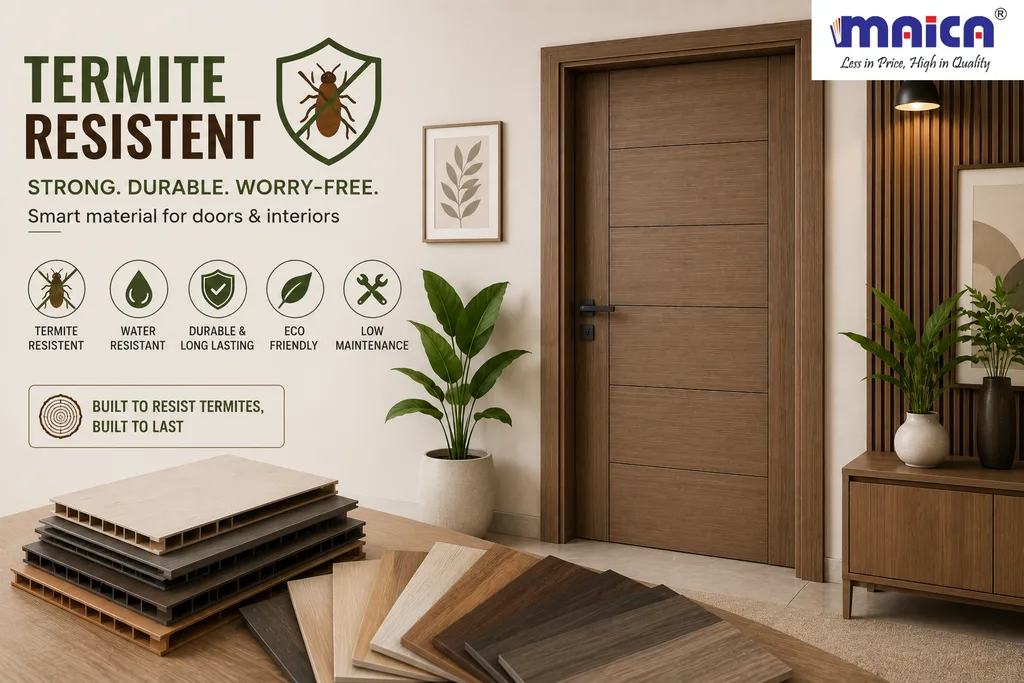
Termite-resistant WPC Door and Furniture are the Future? Termites are one of the most frustrating problems homeowners can face when using conventional wooden materials. A door may look perfectly fine from the outside while termites gradually damage the frame, edges or internal portions. The same concern applies to wardrobes, cabinets, kitchen furniture, storage units and other wood-based interior products. This is one reason modern homeowners, architects, builders and interior designers are increasingly looking at WPC (Wood Polymer Composite) as an alternative material for doors and selected furniture applications.
WPC combines wood-based material with thermoplastic polymers to create an engineered product designed for improved resistance to moisture, termites and everyday wear. For applications where conventional wood may require more protection and maintenance, quality WPC can offer a practical alternative.
For buyers searching for a termite resistant WPC material for doors and home furniture, the important question is not simply whether WPC is better than wood. The real question is whether the material is appropriate for the specific application, environment and expected performance.
This is where choosing the right manufacturer becomes important. Maica Group, through Maica Plastiwood Pvt. Ltd., is a leading WPC door manufacturer in India, manufacturing WPC doors and frames at its Indore facilities and supplying products across India.
What Is Termite-Resistant WPC Material?
WPC stands for Wood Polymer Composite. It is an engineered material made by combining wood fibre or wood flour with thermoplastic polymers and other performance-enhancing ingredients.
Unlike a conventional solid-wood product, WPC is manufactured as a composite material. This allows manufacturers to engineer products with characteristics suited to modern construction and interior applications.
WPC doors, for example, are designed to provide the appearance and workability associated with wood while offering properties such as moisture resistance, termite resistance and dimensional stability.
The exact performance of a WPC product depends on its formulation, density, manufacturing process, intended application and quality control. Therefore, buyers should compare actual product specifications rather than assuming every WPC product on the market has identical performance.
Why Are Termites a Problem for Wooden Doors and Furniture?
Termites feed on cellulose-based material, which makes many conventional wood products vulnerable to termite activity.
The problem can be particularly serious in door frames because the lower portions of a frame may be exposed to moisture and conditions that encourage termite activity. Once termites enter a wooden frame, the damage may remain hidden for some time.
Typical signs can include:
- Hollow or weakened wood
- Loose hinge screws
- Damaged door-frame sections
- Crumbling wood near the floor
- Small holes or termite pathways
- Doors becoming difficult to operate
Furniture can experience similar problems. Wardrobes, kitchen cabinets, storage units and other wooden structures can become difficult and expensive to repair once significant termite damage has occurred.
This is why material selection should be considered before construction or furniture manufacturing rather than only after a termite problem appears.
Is WPC Termite Resistant?
Quality WPC products are designed to provide strong resistance to termites and other wood-damaging pests, which is one of their major advantages over conventional wood-based materials.
However, it is important to understand the difference between a product being termite resistant and making an unsupported claim that every WPC product is absolutely “100% termite proof.”
Different WPC products can have different formulations and manufacturing characteristics. Performance can also depend on installation, application and environmental conditions.
For this reason, buyers should ask manufacturers for product information and technical details relevant to the intended use.
Maica Group specifically lists termite resistance among the features of its WPC products, along with properties such as water resistance, durability and low maintenance.
For a homeowner replacing conventional wooden doors in a termite-prone environment, this resistance can be a major reason to consider WPC.
Why Choose Termite-Resistant WPC for Doors?
A door is used every day. It needs to withstand repeated opening and closing, hardware installation, cleaning, humidity and general household use.
WPC doors can be suitable for a range of residential and commercial applications because they combine several useful characteristics.
1. Termite Resistance
This is one of the biggest reasons people consider WPC doors.
Unlike conventional timber, quality WPC is designed to resist termite and pest damage, making it particularly attractive for areas where termite problems are common.
2. Moisture Resistance
Moisture can create problems for conventional wood, particularly around bathrooms, kitchens, utility areas and other damp locations.
WPC’s moisture-resistant characteristics make it suitable for applications where exposure to humidity or occasional moisture is a concern. Maica Group offers WPC doors specifically for applications including bathrooms, kitchens, bedrooms, balconies and offices.
3. Low Maintenance
Wooden doors may require periodic polishing, painting, protective treatment or repairs depending on the material and environment.
WPC generally requires less routine maintenance, although proper installation and normal cleaning are still important.
4. Dimensional Stability
A major concern with wood-based products is movement caused by changes in moisture and environmental conditions.
Quality WPC products are engineered to provide improved dimensional stability compared with many conventional wood applications.
5. Design Flexibility
Choosing a termite-resistant material does not mean compromising on appearance.
Modern WPC doors are available in multiple finishes and designs. Maica Group’s current range includes plain, laminated, textured, digital, moulded, grooved and CNC-style WPC doors.
Can WPC Be Used for Home Furniture?
Yes, WPC and related composite materials can be considered for several furniture and interior applications where moisture resistance, termite resistance and low maintenance are important.
Potential applications include:
Wardrobes
Wardrobes can be vulnerable to termites because they often contain large amounts of wood-based material. WPC can be considered where resistance to moisture and pests is a priority.
Kitchen Cabinets
Kitchens are exposed to water vapour, spills, cleaning products and regular daily use. A moisture-resistant material can therefore be useful for cabinet construction.
Bathroom Furniture
Bathrooms are one of the most obvious applications for moisture-resistant materials. WPC can be considered for suitable bathroom furniture and storage applications.
Storage Cabinets
Storage furniture can remain in place for many years, making durability and resistance to environmental conditions important considerations.
TV Units and Interior Furniture
For decorative furniture, WPC can be combined with suitable surface finishes to create contemporary interior designs.
Office Furniture
WPC-based products can also be considered for selected office applications where durability and low maintenance are important.
The exact suitability should always be evaluated according to the product specification, load requirement, fabrication method and location of installation.
WPC vs Wood for Termite-Prone Areas
When selecting a material, it is useful to understand the fundamental differences between WPC and conventional wood.
| Factor | WPC | Conventional Wood |
|---|---|---|
| Termite resistance | Designed for strong termite resistance | May require termite protection/treatment |
| Moisture resistance | Generally high for suitable WPC products | Depends heavily on wood type and treatment |
| Maintenance | Generally low | Can require more maintenance |
| Appearance | Available in multiple finishes | Natural wood appearance |
| Design options | Plain, laminated, digital, CNC and other finishes | Can be polished, painted, carved or laminated |
| Dimensional stability | Generally good when properly manufactured | Can change with moisture and environment |
| Application | Doors, frames and selected interior uses | Doors, furniture and many other applications |
| Material selection | Quality and formulation are important | Species, seasoning and treatment are important |
This does not mean wood is a poor material. Natural timber remains an excellent choice for many applications. The decision should instead be based on the property’s environment, design requirements, budget, maintenance expectations and performance needs.
WPC vs Plywood for Doors and Furniture
Another common comparison is WPC vs plywood.
Plywood has been widely used in Indian furniture and interior construction for decades. It has established fabrication methods and is available in many grades.
However, WPC offers advantages that can be particularly useful in moisture- and termite-prone applications.
| Factor | WPC | Plywood |
| Termite resistance | A key advantage of suitable WPC products | Depends on grade and treatment |
| Moisture resistance | Generally high | Depends on plywood grade and exposure |
| Maintenance | Generally low | Depends on application and finish |
| Furniture applications | Suitable for selected applications | Widely used |
| Door applications | Suitable for many door applications | Widely used |
| Surface finishes | Multiple options available | Multiple finishing options |
| Selection | Product quality and formulation matter | Grade and quality matter |
The right material depends on the specific project. A bathroom cabinet, bedroom wardrobe and heavy-duty commercial application may each require a different material specification.
What Should You Check Before Buying WPC?
Not all WPC products should be evaluated purely on price.
Before purchasing WPC doors or WPC material for furniture, consider the following:
1. Product Composition
Ask what the product is made from and whether the manufacturer provides relevant technical information.
2. Density and Thickness
Density and thickness influence the suitability of a product for different applications.
Do not select a product only because it has the lowest price per square foot.
3. Manufacturing Quality
Consistent manufacturing is important for dimensions, surface quality, machining and long-term performance.
4. Intended Application
A door, wardrobe, kitchen cabinet and bathroom application can have different requirements.
Tell the manufacturer where the product will be installed.
5. Surface Finish
Consider whether you need:
- Plain
- Laminated
- Textured
- Digital print
- Grooved
- CNC
- Moulded
- Other decorative finishes
6. Door Frame Compatibility
If you are replacing a wooden door, consider the frame as well.
Using a termite-resistant WPC shutter with a vulnerable wooden frame may not provide the same overall material advantage as selecting a suitable WPC door and frame system.
Maica Group manufactures both WPC doors and WPC door frames, including plain, laminated, textured and digital frame options.
7. Manufacturer Support
Choose a manufacturer that can provide product information, application guidance and appropriate support.
Why Choose Maica Group as Your WPC Door Manufacturer in India?
Selecting a WPC door is only one part of the decision. The manufacturer behind the product matters just as much.
Maica Group is a leading WPC door manufacturer in India, with manufacturing plants in Indore, Madhya Pradesh, and a distribution network serving customers across India.
Maica Plastiwood Pvt. Ltd. manufactures WPC doors and frames and focuses on combining functionality, durability and contemporary design for modern interior applications.
In-House WPC Door Manufacturing
Maica Group states that its WPC doors and frames are manufactured at its own facilities in Indore. This gives the company a direct role in the manufacturing process rather than simply functioning as a reseller.
Wide Range of WPC Door Designs
Different projects require different aesthetics.
Maica Group’s WPC door collection includes:
- Plain WPC Doors
- Laminated WPC Doors
- Textured WPC Doors
- Digital WPC Doors
- CNC-designed doors
- Grooved doors
- Moulded doors
- Carved doors
This allows homeowners, architects and interior designers to select designs according to the character of the project.
WPC Doors for Different Applications
WPC doors can be used in various residential and commercial environments.
Maica Group lists applications including:
- Bathrooms
- Kitchens
- Bedrooms
- Living areas
- Balconies
- Offices
- Commercial interiors
The appropriate product should be selected according to the specific application and installation conditions.
WPC Door Frames
The frame is just as important as the door shutter.
Maica Group manufactures WPC door frames designed as an alternative to conventional wooden frames, with plain, laminated and textured options available.
For homeowners concerned about termites, considering both the shutter and frame can be a more complete approach than replacing only the door leaf.
Manufacturing and Product Development
Maica Group describes its manufacturing approach as involving raw-material selection, controlled production, modern machinery, precision machining and quality inspection.
For buyers, this highlights an important point: WPC performance is not determined by the word “WPC” alone. Manufacturing quality and product consistency matter.
Why WPC Is Becoming Popular for Modern Indian Homes
Indian homes can experience a combination of humidity, monsoon moisture, temperature variation, termites and heavy everyday use.
This makes material selection particularly important.
Homeowners increasingly want products that combine:
- Durability
- Termite resistance
- Moisture resistance
- Low maintenance
- Modern appearance
- Design flexibility
- Long-term usability
WPC addresses several of these requirements, which is why it has become an increasingly visible material in modern doors and interior applications.
For manufacturers such as Maica Group, the opportunity is to combine the functional advantages of WPC with designs that work in contemporary Indian homes and commercial spaces.
7 Things to Check Before Buying a Termite-Resistant WPC Door
Before placing an order, ask these seven questions:
1. Is the product suitable for my application?
Bathroom, bedroom, main entrance, office and commercial applications can have different requirements.
2. What is the product composition?
Understand what you are actually purchasing.
3. What density and thickness should I choose?
Ask the manufacturer for the appropriate specification rather than choosing solely on price.
4. Is the frame available in WPC?
A suitable WPC frame can complement the benefits of a WPC door.
5. What finishes are available?
Choose a finish that matches the interior design and expected usage.
6. Can the manufacturer provide technical information?
A professional manufacturer should be able to explain the product and its intended applications.
7. Who will manufacture and supply the product?
Choosing an established WPC door manufacturer in India can make product selection, support and bulk procurement easier.
Frequently Asked Questions About Termite-Resistant WPC
Is WPC resistant to termites?
Quality WPC products are designed to provide resistance to termites and wood-damaging pests. However, performance depends on product formulation, manufacturing quality and application. Buyers should refer to the manufacturer’s product specifications.
Are WPC doors better than wooden doors in termite-prone areas?
WPC can be a strong alternative where termite resistance is a priority. Wooden doors can also perform well when the correct wood, treatment, installation and maintenance are used. The right choice depends on the project.
Can WPC be used for door frames?
Yes. WPC is used for door frames as well as door shutters. Maica Group manufactures WPC door frames in different finishes for residential and commercial applications.
Can WPC be used for wardrobes?
WPC can be considered for wardrobes and other furniture applications where resistance to moisture and termites is important. The product should be selected according to the structural and design requirements.
Can WPC be used for kitchen cabinets?
Yes, suitable WPC products can be used for kitchen applications. Moisture resistance and low maintenance make WPC attractive for areas exposed to humidity and occasional water.
Is WPC suitable for bathrooms?
WPC is particularly attractive for bathroom applications because of its moisture-resistant characteristics. Maica Group lists bathrooms among the applications for its WPC doors.
Which is better: WPC or plywood?
Neither material is automatically better for every application. WPC can have advantages in moisture- and termite-prone environments, while plywood remains widely used for furniture and construction. Compare the grade, quality, application and total requirements before deciding.
How do I choose a good WPC door manufacturer in India?
Look for an established manufacturer with manufacturing capabilities, a clear product range, technical information, consistent quality, application guidance and reliable customer support. Maica Group manufactures WPC doors and frames in Indore and supplies products across India.
Is WPC completely maintenance-free?
WPC is generally considered a low-maintenance material, but no product should be treated as requiring absolutely no care. Correct installation, normal cleaning and appropriate use remain important.
Can WPC doors be customized?
Customization depends on the manufacturer and product range. Maica Group states that it provides custom solutions for sizes and designs and offers multiple WPC door styles and finishes.
Final Thoughts: Is Termite-Resistant WPC Worth Considering?
If termites, moisture and maintenance are major concerns for your home or project, termite-resistant WPC is certainly a material worth considering.
The biggest advantage is not simply termite resistance. A quality WPC product can bring together several practical characteristics—including moisture resistance, durability, low maintenance and design flexibility—within one engineered material.
For doors, the decision should also include the frame. For furniture, buyers should consider density, thickness, fabrication, finish and the conditions in which the furniture will be used.
Most importantly, don’t select WPC based only on the lowest price or the word “WPC” printed on a product brochure. Compare the manufacturer’s quality, product specifications, manufacturing capabilities and support.
Choose Maica Group for WPC Doors in India
For homeowners, architects, builders, interior designers and project buyers looking for a reliable WPC door manufacturer in India, Maica Group offers a broad range of WPC doors and frames manufactured in India.
From plain and laminated doors to textured, digital, grooved, moulded and CNC designs, Maica’s range is designed to combine modern aesthetics with the practical advantages of WPC.
If you are planning WPC doors for a new home, renovation, commercial project, office, hotel or interior application, connect with Maica Group to discuss suitable WPC door solutions, designs, specifications and project requirements.
To Know Our journey Follow us
Maica Group – Leading WPC Door Manufacturer in India.