
Choosing the right door manufacturer is an important decision for any construction project. Whether you are building homes, apartments, hotels, or commercial spaces, the quality of your doors matters. However, choosing a suitable supplier involves more than comparing prices. We should visit a WPC doors Factory.
A reliable WPC doors factory can help you evaluate product specifications, finishing options, door-frame compatibility, and bulk-order requirements. Therefore, buyers should understand how WPC doors are manufactured and what to check before placing an order.
WPC doors have become an option for buyers looking for alternatives to conventional wooden doors. They are available in different designs and finishes, depending on the manufacturer’s product range.
At Maica Group, we understand the importance of selecting suitable doors and frames for different applications. This guide explains the manufacturing process, quality checks, and important buying considerations.
Most importantly, it will help you understand why choosing a manufacturing partner based on quality, consistency, and overall value can be more useful than selecting a supplier based only on price.
What Is a WPC Doors Factory?
A WPC doors factory manufactures doors and related products using wood-plastic composite materials. WPC combines wood-based material with polymer components. The formulation and manufacturing method can vary between manufacturers.
A factory may handle several stages, including material preparation, processing, sizing, surface finishing, inspection, and packaging. However, the exact process depends on the product design and production technology.
In contrast, a distributor generally purchases products from manufacturers and supplies them to customers. Some distributors maintain local stock, which can be useful for smaller orders or urgent requirements.
For builders and bulk buyers, understanding this difference helps determine the most suitable purchasing channel.
WPC doors are used in residential interiors, apartments, offices, hotels, and other commercial spaces. Their suitability depends on the product specifications, installation conditions, and intended application.
Consequently, buyers should review the actual product details before selecting a door for a particular project.
How Are WPC Doors Manufactured?
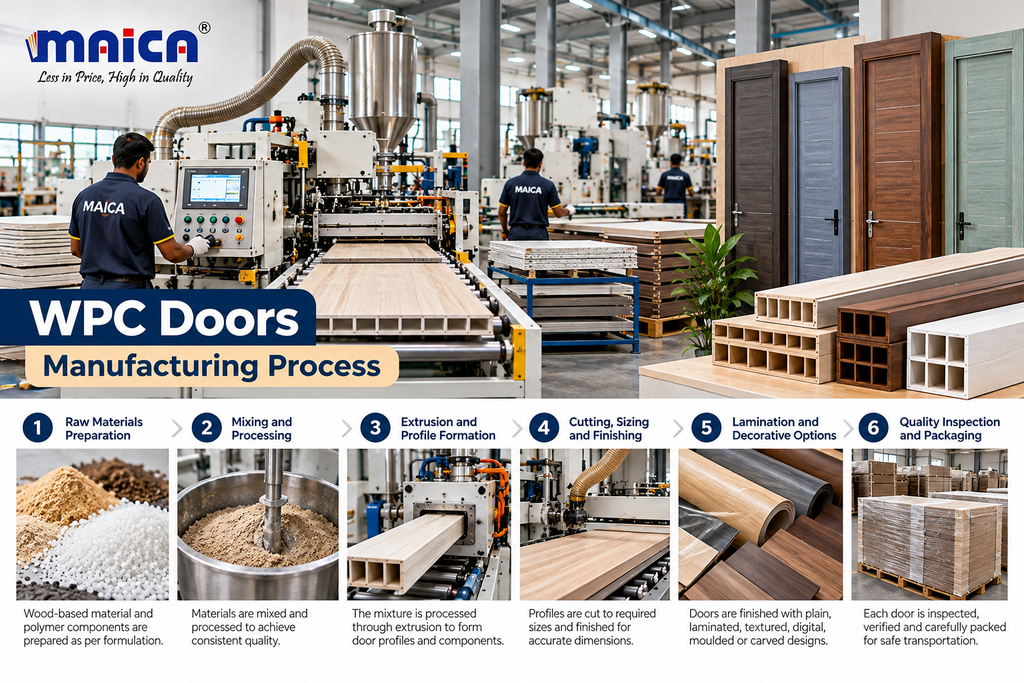
The WPC door manufacturing process involves several stages. Each stage contributes to the finished product. Therefore, understanding these steps can help buyers ask better questions when evaluating a manufacturer.
1. Raw Materials and Material Preparation
WPC formulations generally combine wood-based material and polymer components. Manufacturers may also use additives to support processing and achieve specific material properties.
However, formulations differ. The quality of the finished product cannot be judged by one ingredient alone.
Buyers should request relevant product specifications and available technical documentation. This is especially important when purchasing doors in large quantities.
2. Mixing and Material Processing
The raw materials are prepared and processed according to the manufacturer’s formulation. Consistency during this stage helps support consistent production.
Furthermore, suitable process control can help manufacturers maintain the intended product specifications.
The exact equipment and processing sequence depend on the manufacturing system. Therefore, buyers should avoid assuming that every factory uses an identical process.
3. Extrusion and Profile Formation
Some WPC manufacturing processes use extrusion to form profiles or other product components. The material passes through specialized equipment to achieve the required shape.
The process must suit the intended product. Not every WPC door uses the same construction method.
For this reason, buyers should ask about the construction and specifications of the particular door they plan to purchase.
4. Cutting, Sizing and Finishing
After processing, components may require cutting, sizing, machining, or additional finishing.
Accurate dimensions are important because they influence installation and fitting. Similarly, a consistent surface finish contributes to the final appearance.
For bulk orders, buyers should confirm the required sizes and tolerances before production begins.
5. Lamination and Decorative Options
WPC doors are available in different finishes, depending on the manufacturer’s range. Options may include plain, laminated, textured, digital, moulded, and carved designs.
Each finish serves a different design preference. For example, a simple finish may suit a minimal interior, while a decorative design may complement a more detailed interior scheme.
Nevertheless, availability varies by manufacturer. Buyers should review actual samples or product photographs before finalizing their selection.
6. Quality Inspection and Packaging
Before dispatch, manufacturers may conduct dimensional checks, visual inspections, and other checks specified for the product.
Packaging is also important. Proper handling and packaging help reduce the risk of damage during transportation.
For dealers and contractors, these steps matter because damaged products or specification mismatches can disrupt project schedules.
Therefore, ask the manufacturer about its inspection procedures, packaging methods, and order-verification process.
How to Identify a Reliable WPC Door Manufacturer
Selecting a WPC door manufacturer requires a practical evaluation. Instead of relying only on sales claims, verify the details that matter to your project.
Use the following checklist before placing an order.
Product specifications: Confirm the door dimensions, thickness, finish, construction, and intended application.
Weight and density: Where relevant, ask for the specified weight or density and compare products with equivalent dimensions and construction.
Surface quality: Review the finish, edges, and overall appearance. If possible, inspect a physical sample.
Product range: Check whether the manufacturer offers the door styles and sizes you require.
Door-frame compatibility: Confirm the frame dimensions, wall thickness requirements, and installation details.
Quality checks: Ask what inspections are performed and whether relevant documentation is available.
Production and supply capability: Discuss the required quantity, order schedule, and availability.
Packaging and transport: Confirm how the products will be packed and delivered.
Commercial terms: Review the quotation, payment terms, delivery responsibilities, and warranty terms where offered.
Customer support: Choose a supplier that communicates clearly and provides the information you need before ordering.
Moreover, request written confirmation of the agreed specifications. This creates a clear reference for both parties.
A reliable purchasing decision begins with verification, not assumptions.
Why Choose a Reliable WPC Doors Factory Instead of Buying Based Only on Price?
The lowest quotation may appear attractive, especially when purchasing hundreds of doors. However, the initial price does not tell the whole story.
A better decision considers product specifications, consistency, transport, installation requirements, and the support available from the supplier.
Consistent Product Quality
When several doors are required for one project, consistency becomes important.
Buyers should compare dimensions, weight, surface finish, and other relevant specifications. Differences between products may create additional inspection or installation work.
Therefore, review samples and confirm the agreed specifications before placing a bulk order.
Better Long-Term Value
The purchase price is only one part of the overall cost.
Product suitability, maintenance requirements, replacement needs, and expected service life can also affect value. For this reason, buyers should evaluate the product against the intended application.
However, a higher price does not automatically guarantee better performance. Always compare available evidence and equivalent specifications.
Clear and Reliable Specifications
A detailed quotation makes comparison easier. It should identify the product being supplied, its dimensions, thickness, finish, quantity, and other relevant specifications.
Where applicable, confirm density, weight, test documentation, and installation requirements.
In addition, make sure the quotation describes the door frame separately when it is included. This helps prevent confusion about what the price covers.
Consistency Across Bulk Orders
Builders, contractors, and distributors often need multiple doors for the same project. Consistency across batches can help simplify planning and product acceptance.
Before ordering, confirm the agreed specifications and the process for handling any variation.
Similarly, ask how repeat orders will be matched to the original requirements.
Compatible WPC Door Frames
The door and frame should be evaluated together when both are required.
Frame dimensions, wall thickness, door dimensions, and installation details influence compatibility. Therefore, buyers should verify these measurements before placing an order.
A matching finish may also be desirable for a coordinated appearance. However, finish availability and compatibility should be confirmed with the manufacturer.
Reliable Delivery and Project Planning
Construction schedules depend on timely material supply. Delays can affect installation plans and coordination with other trades.
Consequently, discuss production lead times, packaging, dispatch schedules, and transportation responsibilities in advance.
Obtain written confirmation wherever possible. This makes expectations clearer for both the buyer and supplier.
Technical Support and Accountability
Good communication is valuable before and after a purchase.
A dependable supplier should provide clear product information and explain relevant commercial terms. Buyers should also understand how questions or product-related concerns will be handled.
Furthermore, documented specifications and agreed terms reduce avoidable misunderstandings.
Compare Total Value, Not Just the Price Per Door
Consider two hypothetical quotations for a construction project.
Now supplier A offers a lower price, but the quotation does not clearly specify the frame, packaging, or transportation. Supplier B provides a detailed quotation covering the agreed product specifications and delivery arrangements.
Supplier B may initially appear more expensive. However, the buyer needs to compare both offers on the same basis before deciding.
Neither quotation should be accepted without verification. The right choice depends on the actual products, commercial terms, and project requirements.
Before comparing prices, evaluate:
- Product specifications and quality.
- Door and frame compatibility.
- Order quantity and availability.
- Packaging and transportation costs.
- Expected wastage and replacement costs.
- Warranty terms, where offered.
- Delivery commitments and after-sales support.
The lowest quotation may reduce your initial purchase cost. However, the right manufacturing partner can help you make a more informed decision about quality, consistency, project requirements, and long-term value. Before placing your next order, compare the complete offering—not just the price per door.
WPC Door Factory vs WPC Door Distributor
Both manufacturers and distributors can serve useful roles in the supply chain. The right choice depends on your purchasing requirements.
A manufacturer may be suitable when you need larger quantities, detailed product specifications, or direct discussions about manufacturing options.
A distributor, on the other hand, may offer local stock, smaller quantities, or quicker access to available products.
Before deciding, compare the following factors:
- Product availability: Can the supplier provide your required sizes and finishes?
- Order quantity: Are your quantities suitable for the supplier’s business model?
- Customization: Are the required options available?
- Delivery: Can the supplier meet your delivery requirements?
- Technical support: Can you obtain the specifications and installation information you need?
- Commercial terms: Are the price, freight, payment terms, and other charges clearly stated?
For bulk orders, contacting a manufacturer may be worthwhile. Nevertheless, compare the complete offer before choosing your supplier.
Why Source WPC Doors and Door Frames Together?
When a project requires both doors and frames, evaluating them together can simplify procurement.
First, confirm the door dimensions and frame specifications. Next, verify wall thickness requirements and installation details. Finally, check whether the selected finishes are available together.
This approach helps buyers coordinate product selection before materials reach the site.
For builders and contractors, it can also simplify quantity planning and quotation comparisons.
Maica Group offers WPC doors and WPC door frames for buyers exploring these product categories. You can review the available door range on the Maica WPC Doors.
Before placing an order, discuss your requirements and verify the specifications of the products you intend to purchase.
WPC Doors for Builders, Dealers and Bulk Buyers
Different buyers have different priorities. Therefore, the purchasing process should reflect the intended use and order requirements.
For Builders and Contractors
Builders need to coordinate product specifications, quantities, site measurements, and delivery schedules.
Confirm the door sizes, frame requirements, and installation details early. In addition, request a clear quotation for the required quantities.
This helps the project team plan procurement more effectively.
For Dealers and Distributors
Dealers should consider product range, customer demand, stock planning, and repeat-order requirements.
Before establishing a supply relationship, review available products and commercial terms. Also, discuss how specifications and finishes will be confirmed for future orders.
Dealers interested in expanding their building-materials portfolio can enquire about available WPC door and frame options.
For Architects and Interior Designers
Design professionals need to coordinate appearance with practical requirements.
Review the available finishes, dimensions, and samples before specifying a product. Moreover, confirm that the selected door and frame meet the project’s installation requirements.
For Institutional and Commercial Projects
Large projects may involve detailed specifications, documentation, and planned delivery schedules.
Buyers should confirm the applicable project requirements before placing an order. If specific certifications or test reports are required, verify the relevant documentation directly.
Maica Group’s product range can be explored as part of this evaluation. Final selection should always depend on the project’s requirements and verified product details.
How to Choose the Right WPC Doors Factory in India
Use this step-by-step process to make a more informed purchasing decision.
Step 1: Define your requirements. Identify the application, quantity, sizes, thicknesses, and preferred finishes.
Step 2: Shortlist suitable manufacturers. Focus on suppliers offering the products you actually need.
Step 3: Request specifications. Obtain product details and relevant documentation before comparing quotations.
Step 4: Evaluate samples. Check the finish, dimensions, and other characteristics relevant to your application.
Step 5: Confirm frame compatibility. Verify door and frame dimensions, wall thickness, and installation details.
Step 6: Compare equivalent quotations. Ensure that the products, quantities, included items, and delivery terms are comparable.
Step 7: Confirm the delivery schedule. Discuss production lead times, packaging, transportation, and dispatch responsibilities.
Step 8: Document the agreement. Keep the final specifications and commercial terms in writing.
Step 9: Confirm order details. Check quantities, finishes, and delivery information before production or dispatch proceeds.
This process helps buyers compare suppliers fairly. It also reduces the risk of misunderstandings caused by incomplete quotations.
If you are exploring a WPC doors factory in India, consider Maica Group alongside other suitable manufacturers. Review the available products, request relevant specifications, and discuss your requirements before making a decision.
Frequently Asked Questions About WPC Doors Factories
1. What is a WPC doors factory?
A WPC doors factory manufactures WPC doors and, in some cases, related products such as door frames. Its processes and capabilities depend on the manufacturer and product range.
2. How are WPC doors manufactured?
Manufacturing may involve material preparation, mixing, processing, forming, cutting, finishing, and inspection. The exact process varies by product and manufacturer.
3. How do I choose a reliable WPC door manufacturer in India?
Check product specifications, samples, dimensions, surface finish, quality procedures, delivery commitments, and commercial terms. Moreover, confirm important details in writing before placing an order.
4. Can I buy WPC doors and door frames in bulk directly from a factory?
Bulk purchasing may be possible, depending on the manufacturer’s products, availability, and commercial terms. Contact the manufacturer to confirm your quantities, specifications, and delivery requirements.
5. What should I check before placing a WPC door factory order?
Confirm dimensions, thickness, finish, frame compatibility, quantities, packaging, delivery schedules, and payment terms. Also, request a detailed quotation that clearly identifies the products being supplied.
6. Should I choose a WPC door supplier based only on price?
No. Price is important, but it should be compared alongside product specifications, quality, transport costs, warranty terms where offered, and supplier support. A fair comparison helps you understand the overall value of each quotation.
Looking for a WPC Doors Factory for Your Next Project?
Choosing the right manufacturing partner starts with clear specifications and a fair comparison.
Maica Group offers WPC doors and WPC door frames for buyers exploring options for residential, commercial, and construction projects.
Whether you are a builder, contractor, dealer, distributor, or project buyer, start by identifying your requirements. Then review the available products and confirm the specifications that matter to your application.
Explore Maica WPC Doors
Contact the Maica Group team to discuss product specifications, bulk requirements, and quotations or visit WPC doors factory manufactures doors and related products using wood-plastic composite materials.
Make your next purchasing decision with a clear understanding of quality, compatibility, and overall value.
For More updates, follow us: