
A door is only as good as the frame supporting it. The frame holds the door shutter in position, carries the hinges and hardware, maintains alignment and plays an important role in the overall durability of the door system.Traditionally, door frames in India have been made from materials such as hardwood and other forms of natural timber. However, moisture, termites, swelling, shrinkage, maintenance and inconsistent dimensions can become concerns depending on the type and quality of wood used.This is where WPC Choukhat have become an increasingly considered alternative.
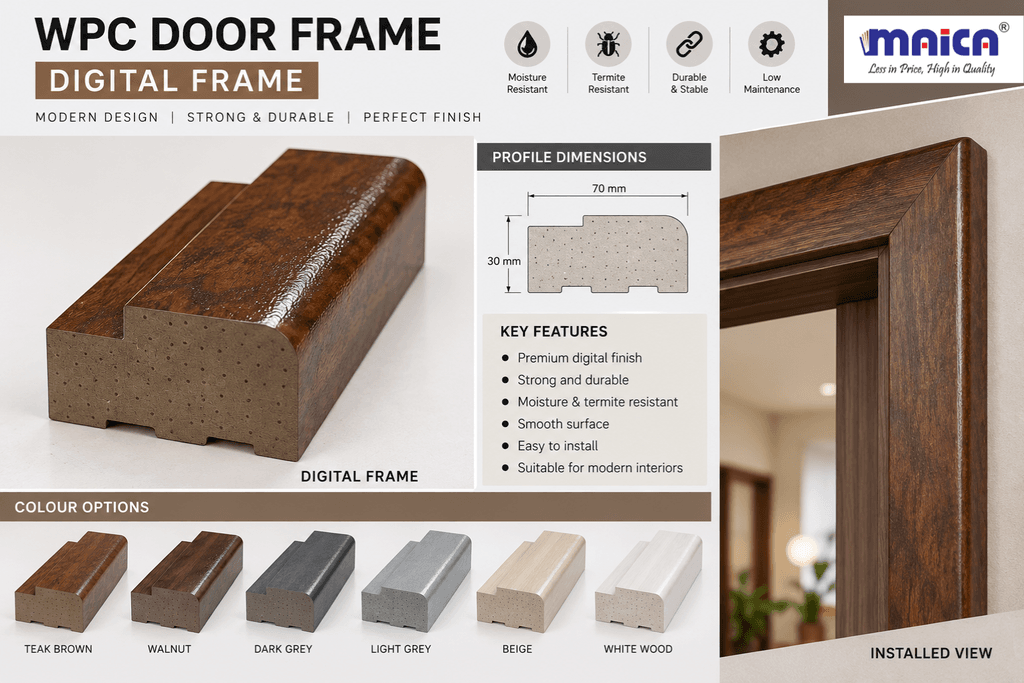
WPC, or Wood Plastic Composite, combines wood-based material with a polymer matrix and suitable additives to create a material that can be manufactured into consistent profiles. WPC door frames are used in residential buildings, commercial spaces, offices, hotels, apartments, institutional projects and other applications where resistance to moisture and termites is important.
But not every WPC door frame is the same.
Density, profile design, dimensions, formulation, manufacturing process, reinforcement, finish and installation method can all influence the performance of a frame.
This complete guide explains what WPC is, how WPC door frames are made, WPC vs wood, types of frames, density, single-Pattam and double-Pattam frames, sizes, thickness, pricing factors, benefits, applications, installation and how to choose the right WPC door frame.
What Is WPC?
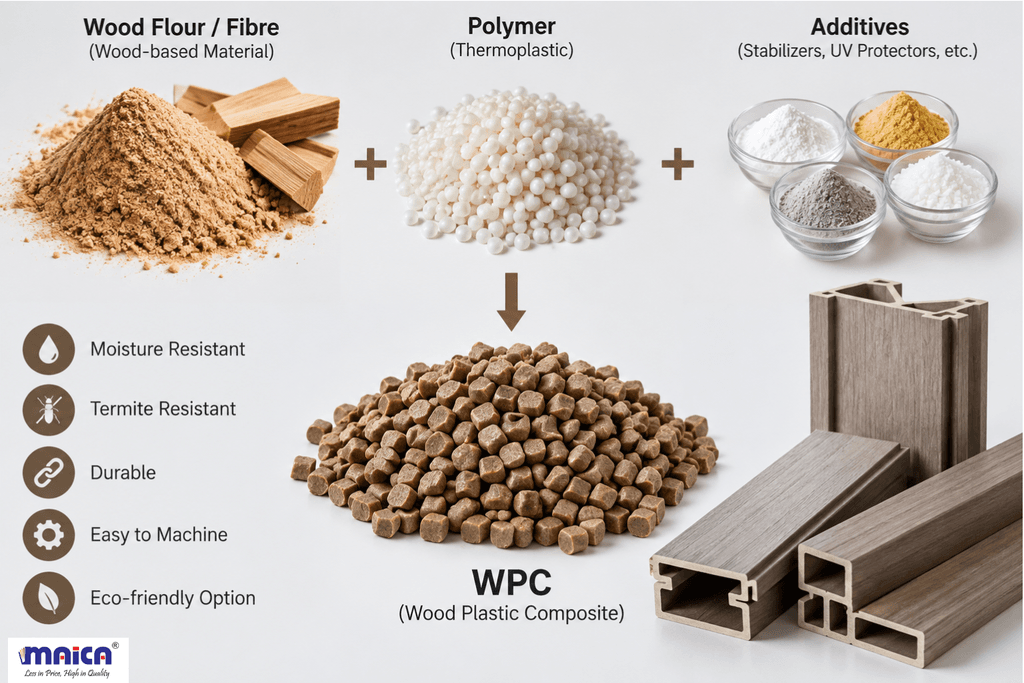
WPC stands for Wood Plastic Composite.
As the name suggests, WPC is a composite material made by combining a wood-based component with a thermoplastic polymer and other additives.
The wood component may be in the form of wood fibre, wood flour or another plant-based filler. The polymer provides the plastic matrix, while additives can be used to improve processing and selected properties of the finished material.
In simple terms:
Wood-based material + Polymer + Additives = WPC
The exact composition and formulation can vary between manufacturers and products.
This is important because two products sold as “WPC” may not necessarily have identical performance.
Why is WPC different from natural wood?
Natural wood is a biological material. Its properties can vary according to species, grain, moisture content, treatment and other factors.
WPC is an engineered composite. It can be manufactured into specific profiles with controlled dimensions and a more consistent structure.
Depending on its formulation and manufacturing quality, WPC can offer useful characteristics such as:
- Moisture resistance
- Resistance to termite attack
- Resistance to rot and decay
- Dimensional consistency
- Consistent profile dimensions
- Easy machining
- Low routine maintenance
- Compatibility with different interior applications
WPC can also be cut, drilled, machined and processed using suitable tools and methods, making it practical for door-frame manufacturing and installation.
What Is a WPC Door Frame?
A WPC door frame, also called a WPC chaukhat or WPC door jamb/frame, is a door-frame profile manufactured from Wood Plastic Composite.
The frame is installed around the door opening and provides the structure required to mount and operate the door shutter.
A typical door-frame system performs several functions:
- Supports the door shutter
- Provides a mounting location for hinges
- Helps maintain the alignment of the door
- Provides the required rebate or groove for the shutter
- Connects the door system to the wall opening
- Contributes to the appearance of the finished doorway
The frame therefore should not be selected only by looking at its colour or surface finish.
Its density, section size, profile geometry, dimensions and installation method are also important.
Door Shutter vs Door Frame
These two terms are often confused.
| Door Shutter | Door Frame |
|---|---|
| The moving part of the door | The fixed structure around the opening |
| Opens and closes | Holds and supports the shutter |
| Hinged to the frame | Hinges are fixed to the frame |
| Available in different materials and designs | Available in different profile sizes and materials |
| Determines much of the visible door appearance | Determines alignment, support and frame appearance |
A complete door installation requires the shutter and frame to work together.
WPC Door Frame vs Wooden Door Frame
Wood has been used for door frames for generations and remains a preferred material in many applications. However, WPC offers a different combination of properties.
The correct choice depends on the application, material quality, design, budget and installation requirements.
| Feature | WPC Door Frame | Wooden Door Frame |
|---|---|---|
| Material | Engineered wood-plastic composite | Natural timber |
| Moisture resistance | Generally high, depending on formulation | Depends heavily on wood species and treatment |
| Termite resistance | Generally resistant to termite attack | Requires suitable wood/treatment for protection |
| Rot/decay resistance | Generally resistant compared with untreated wood | Can be affected by prolonged moisture |
| Dimensional consistency | Controlled through manufacturing | Can vary with timber and moisture |
| Maintenance | Generally low | May require more maintenance depending on finish and exposure |
| Machining | Can be cut, drilled and machined | Easy to machine |
| Appearance | Can be plain, textured, laminated or finished | Natural wood appearance |
| Screw holding | Depends on density and profile | Depends on wood species and condition |
| Weight | Depends on density/profile | Depends on timber species |
| Cost | Depends on specification | Depends on timber species and quality |
| Bathroom suitability | Can be suitable when correctly specified | Requires careful material selection and protection |
| Project use | Suitable for many standardized applications | Commonly used in traditional construction |
| Consistency | Engineered profile consistency | Natural variation is possible |
Is WPC always stronger than wood?
No.
It would be incorrect to say that every WPC frame is stronger than every wooden frame.
Performance depends on:
- WPC density
- Material formulation
- Profile design
- Reinforcement
- Manufacturing quality
- Section dimensions
- Screw/hardware design
- Installation quality
- Door weight
- Intended application
A properly engineered WPC frame can be an excellent choice, but buyers should compare actual specifications rather than material names alone.
How Are WPC Door Frames Manufactured?
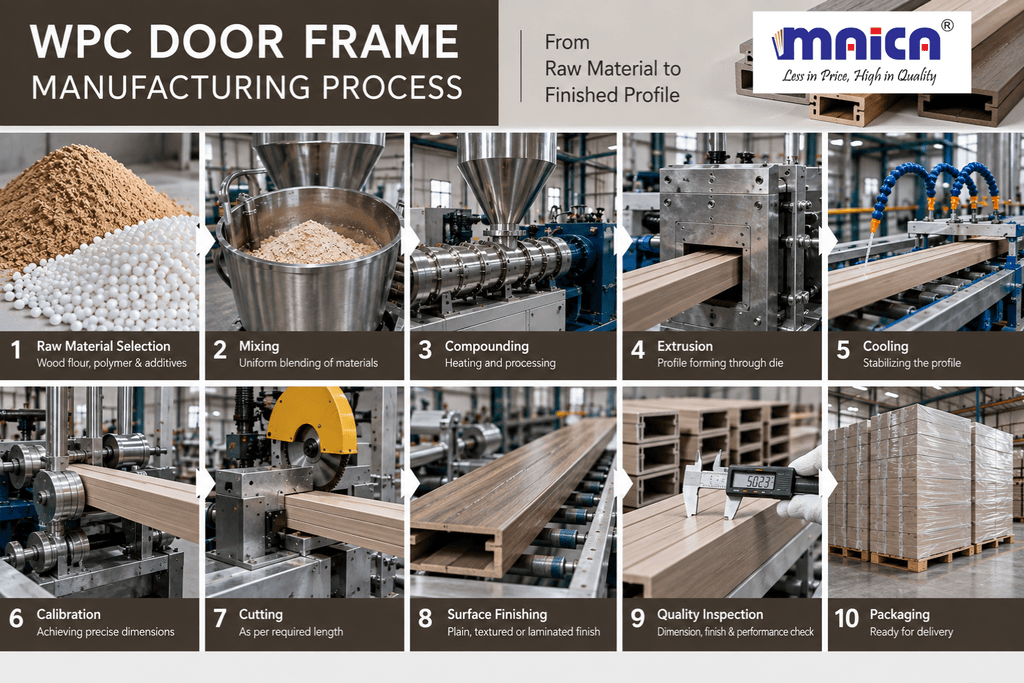
WPC door frames are generally produced through an engineered manufacturing process designed to convert raw materials into consistent door-frame profiles.
The exact formulation and production parameters vary between manufacturers.
A simplified manufacturing process can include the following stages.
1. Raw Material Selection
The manufacturer selects suitable wood-based material, polymer and additives according to the required product characteristics.
The quality and consistency of raw materials can affect the final profile.
2. Preparation of Wood-Based Material
Wood fibre, wood flour or another plant-based filler may be prepared to the required particle size and moisture condition.
Proper preparation helps achieve a more consistent composite.
3. Polymer Selection
A suitable thermoplastic polymer is selected as the matrix material.
The polymer helps bind the wood-based component into a processable composite.
4. Mixing
The wood-based material, polymer and selected additives are combined.
The objective is to achieve a consistent distribution of the different components.
5. Compounding
The material is processed so that the wood component and polymer form a reasonably uniform composite.
This stage has a major influence on material consistency.
6. Heating and Processing
The composite is heated and processed under controlled manufacturing conditions.
Temperature and processing conditions need to be appropriate for the formulation being used.
7. Extrusion / Profile Formation
The prepared WPC material is formed into a door-frame profile using suitable profile-forming equipment.
The die determines the shape and dimensions of the profile.
8. Calibration
The newly formed profile is calibrated to achieve the required dimensions and geometry.
9. Cooling
The profile is cooled under controlled conditions to stabilize its shape.
10. Cutting
Long profiles are cut according to required production or project dimensions.
11. Surface Finishing
Depending on the product, the frame may receive a surface finish such as a plain, textured, laminated, printed or other manufacturer-specific finish.
12. Quality Inspection
The finished frame should be checked for relevant parameters such as:
- Dimensions
- Surface quality
- Profile consistency
- Density
- Straightness
- Finish
- Machinability
- Hardware compatibility
13. Packaging
The finished profiles are packed for transportation and installation.
Why manufacturing quality matters
Two frames can look similar but perform differently.
Manufacturing quality can influence:
- Density
- Strength
- Screw-holding performance
- Dimensional stability
- Surface quality
- Moisture resistance
- Profile consistency
- Overall service performance
This is why choosing a manufacturer is as important as choosing the material.
Types of WPC Door Frames
WPC door frames can be classified in several ways.
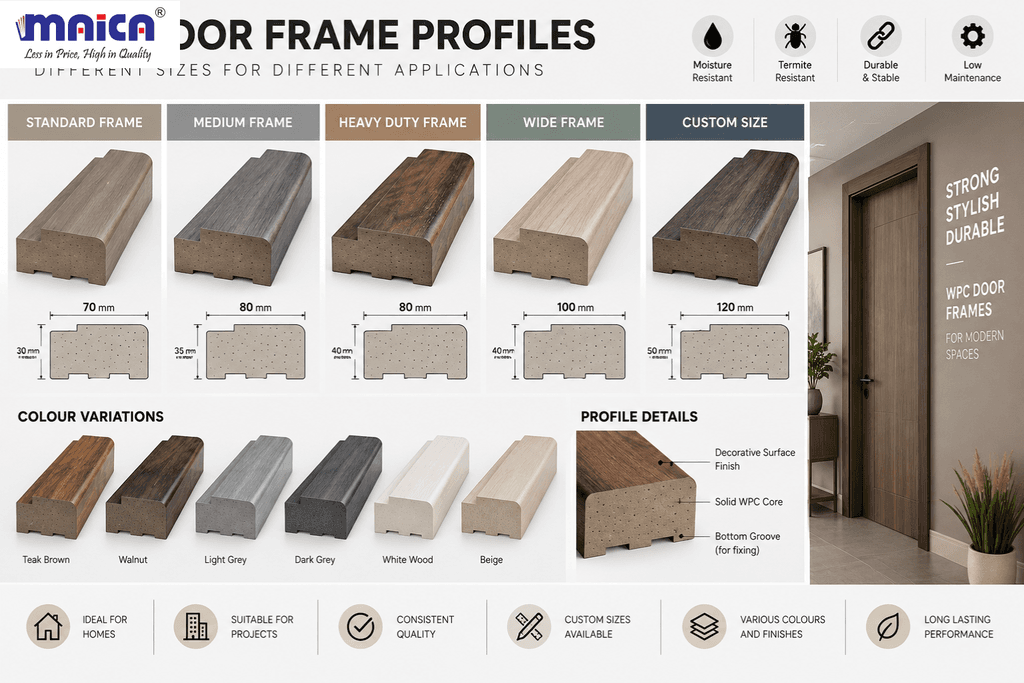
1. Solid WPC Door Frames
Solid profiles contain a substantially solid WPC structure rather than relying primarily on hollow chambers.
They may be considered where higher mass, rigidity or hardware-support requirements are important.
However, the exact construction should always be checked with the manufacturer.
2. Hollow or Chambered WPC Door Frames
Some WPC frame systems may use hollow or chambered profiles.
The purpose can include:
- Reducing weight
- Optimizing material usage
- Achieving a particular profile design
- Providing specific performance characteristics
Not every manufacturer offers hollow/chambered profiles.
Manufacturer-specific: Always check whether the particular WPC frame is solid, hollow or chambered before specifying it for a project.
3. Reinforced WPC Door Frames
Some applications may require reinforcement depending on the door weight, hardware and installation conditions.
Reinforcement can be relevant for:
- Heavy shutters
- High-traffic areas
- Large openings
- Specific commercial applications
The reinforcement method must be selected according to the product and project requirements.
Types Based on Application
WPC door frames can also be selected according to where they will be used.
Residential Door Frames
- Bedroom doors
- Bathroom doors
- Living-room doors
- Kitchen/service areas
- Utility rooms
- Internal doors
Commercial Door Frames
- Offices
- Shops
- Restaurants
- Hotels
- Clinics
- Commercial buildings
Project Applications
- Apartments
- Villas
- Builder projects
- Housing projects
- Institutional buildings
- Renovation projects
The correct profile should always be selected according to door size, shutter weight, wall thickness and installation conditions.
WPC Door Frame Density: Why Is It Important?
Density is one of the most discussed technical parameters when comparing WPC products.
What is density?
Density describes how much mass is contained in a given volume.
The basic relationship is:
Density = Mass ÷ Volume
For WPC products, density is generally expressed in:
kg/m³
Density can influence several practical characteristics, including:
- Weight
- Rigidity
- Screw-holding capability
- Machining behaviour
- Impact resistance
- Dimensional stability
- Application suitability
However, higher density does not automatically mean that a product is better in every situation.
The complete formulation and profile design matter too.
What Is the Best Density for a WPC Door Frame?
There is no single universal density that can simply be declared the “best” for every WPC door frame.
A suitable density depends on:
- Material formulation
- Profile geometry
- Door weight
- Hardware
- Reinforcement
- Application
- Manufacturing process
- Required performance
- Installation method
Different manufacturers offer different density grades and specifications.
General way to understand density
| Density Category | General Characteristics | Consideration |
|---|---|---|
| Lower Density | Lower weight | Suitable only where the profile/application allows |
| Medium Density | Balance of weight and performance | Can suit general applications |
| Higher Density | Greater material mass and rigidity potential | May be preferred for demanding applications |
Important: These are conceptual categories, not universal industry grades.
Do not compare density alone
For example, a buyer should not simply say:
“I want the highest density WPC frame.”
Instead, ask:
- What is the density?
- What is the profile size?
- What is the actual weight per running foot?
- What is the screw-holding performance?
- What door weight is supported?
- Is reinforcement required?
- What is the intended application?
That gives a much more meaningful quality comparison.
Single Pattam vs Double Pattam WPC Door Frames
“Patti” or “Patam” terminology is commonly used in the Indian door-frame market, although terminology can vary between manufacturers and regions.
The two common configurations are:
Single Pattam WPC Door Frame
A single-pattam frame generally uses one primary frame/rebate arrangement.
It can be suitable for certain internal and standard door installations.
Advantages may include:
- Simpler profile
- Lower material requirement
- Clean appearance
- Potentially lower cost
- Suitable for selected wall and shutter configurations
Double Pattam WPC Door Frame
A double-Pattam arrangement provides an additional frame/rebate configuration and may be used where the wall or doorway design requires it.
It may be useful for:
- Wider wall conditions
- Specific architectural detailing
- Certain double-sided finishing requirements
- Selected project applications
| Feature | Single Pattam | Double Pattam |
|---|---|---|
| Profile | Simpler | More elaborate |
| Appearance | Clean/simple | More detailed |
| Wall compatibility | Depends on profile | Can suit wider/different conditions |
| Material requirement | Generally lower | Generally higher |
| Cost | May be lower | May be higher |
| Application | Selected standard doors | Selected wall/door configurations |
Important: Do not select single or double Pattam only based on price. Match the frame to the wall thickness, shutter, rebate and installation requirement.
WPC Door Frame Sizes
There is no single frame size that works for every door.
The correct size depends on:
- Door shutter dimensions
- Wall thickness
- Frame depth
- Frame width
- Rebate
- Shutter thickness
- Hardware
- Installation method
- Project specifications
Common door shutter sizes in Indian construction may include dimensions such as:
- 30 × 78 inches
- 32 × 80 inches
- 36 × 80 inches
These are examples of commonly encountered door sizes, not universal WPC frame standards.
Understanding frame dimensions
A WPC door-frame specification may include:
Width × Depth
For example, a manufacturer may describe a frame profile in millimetres rather than inches.
Always ask the manufacturer to confirm:
- Section size
- Overall frame depth
- Rebate size
- Shutter compatibility
- Recommended wall thickness
- Available lengths
Inches to millimetres
For reference:
1 inch = 25.4 mm
Therefore:
- 2 inches = 50.8 mm
- 2.5 inches = 63.5 mm
- 3 inches = 76.2 mm
- 4 inches = 101.6 mm
Actual frame sections are normally specified using commercially available profile dimensions rather than simply converting every dimension mathematically.
WPC Door Frame Thickness
Thickness should not be evaluated independently from the complete profile.
A thicker-looking frame is not automatically a better frame.
The performance of a WPC door frame can depend on:
- Overall section size
- Profile geometry
- Density
- Material formulation
- Reinforcement
- Rebate design
- Door weight
- Installation method
Manufacturer-specific information
Maica-specific frame thickness, section sizes and available profiles should be confirmed from the current Maica product specification/catalogue before publishing exact numbers on this page.
This is important because product specifications can change with profile development and project requirements.
WPC Door Frame Price in India
One of the most common questions buyers ask is:
“WPC door frame ka price kitna hai?”
The answer depends on the specification.
There is no responsible way to provide one universal WPC door-frame price because a small internal frame and a heavy-duty project frame can have completely different specifications.
Factors affecting WPC door-frame price
1. Density
Higher-density products may require more material and different processing.
2. Profile Size
A larger profile generally uses more material than a smaller section.
3. Frame Depth
A deeper frame can require more material and may be designed for thicker walls.
4. Single or Double Pattam
Different profile configurations can have different material requirements.
5. Finish
Plain, textured, laminated, printed or specialty finishes can affect cost.
6. Reinforcement
If reinforcement is required, it can increase the total system cost.
7. Quantity
Bulk project orders may have different commercial pricing from individual retail purchases.
8. Customization
Customized sizes and profiles may have additional production requirements.
9. Transportation
Freight depends on quantity, distance and logistics.
10. Installation
Installation cost should be considered separately unless it is included in the quotation.
Retail Price vs Bulk Project Price
A homeowner purchasing one or two frames is in a very different buying situation from a builder requiring several hundred frames.
Retail buyers
Usually need:
- Product selection
- Size confirmation
- Price
- Finish
- Installation guidance
Builders/project buyers
Usually need:
- Technical specifications
- Sample approval
- Profile drawings
- Density
- Quantity
- Delivery schedule
- Packaging
- Consistent production
- Project pricing
Important pricing note
Manufacturer-specific price: Maica’s current WPC door-frame price should be obtained according to the required profile, dimensions, quantity, finish and delivery location.
Do not publish an outdated fixed price when specifications or raw-material costs may change.
What to send when requesting a quotation
To get an accurate WPC door-frame quotation, provide:
- Door size
- Wall thickness
- Shutter thickness
- Single/double Pattam requirement
- Required quantity
- Finish
- Project location
- Required delivery date
CTA: Get WPC Door Frame Price & Catalogue
Benefits of WPC Door Frames
1. Moisture Resistance
One of the major reasons WPC is considered for door frames is its resistance to moisture compared with conventional untreated wood.
This can make WPC useful in areas where humidity or occasional moisture exposure is a concern.
2. Termite Resistance
WPC does not provide the same biological food source as untreated natural timber, making it a suitable option where termite resistance is a priority.
However, buyers should verify the manufacturer’s specific test data and warranty rather than assuming every WPC product has identical resistance.
3. Resistance to Rot and Decay
Natural wood can be vulnerable to decay under prolonged moisture exposure if not properly selected and protected.
WPC can offer an advantage in applications where resistance to rot and decay is important.
4. Dimensional Consistency
WPC is manufactured rather than naturally grown.
Controlled manufacturing can provide consistent profiles and dimensions.
This is useful when multiple frames need to be produced for a project.
5. Low Routine Maintenance
A properly finished WPC frame generally does not require the same type of routine wood treatment that some wooden frames may require.
Routine cleaning and hardware inspection are still recommended.
6. Suitable for Humid Areas
WPC can be considered for:
- Bathrooms
- Toilets
- Utility areas
- Humid interior spaces
- Coastal/humid environments
The exact product should be selected according to exposure and manufacturer recommendations.
7. Machinability
WPC frames can generally be cut, drilled and machined using suitable tools.
This allows installers to perform required fitting and hardware work.
8. Consistent Appearance
WPC profiles can be produced with consistent dimensions and a range of finishes.
Depending on the product, options may include:
- Plain finish
- Textured finish
- Woodgrain appearance
- Laminated finish
- Printed/digital finish
Availability varies by manufacturer.
Are There Any Limitations?
Yes.
A good buying decision should consider limitations as well as advantages.
Not every WPC door frame is identical.
Before purchasing, ask about:
- Density
- Actual profile dimensions
- Weight per running foot
- Screw-holding performance
- Material composition
- Profile construction
- Surface finish
- Reinforcement
- Door-weight compatibility
- Warranty
- Installation requirements
- Manufacturer reputation
Why very cheap WPC frames can be risky
Price alone cannot tell you whether a WPC frame is suitable.
A cheaper frame may have a different:
- Density
- Formulation
- Profile size
- Material composition
- Finish
- Manufacturing process
Therefore, compare specification-to-specification, not just price-to-price.
Applications of WPC Door Frames
Residential Applications
WPC door frames can be considered for:
Bedrooms
Suitable where a durable and low-maintenance interior frame is required.
Bathrooms and Toilets
Moisture resistance is a major reason WPC is considered for wet-area door frames.
The selected profile should still be suitable for the particular installation.
Kitchens and Utility Areas
WPC can be considered where moisture exposure is higher than in ordinary dry rooms.
Living Areas
Different surface finishes can allow the frame to complement modern interior designs.
Commercial Applications
WPC door frames can also be used in:
- Offices
- Shops
- Restaurants
- Hotels
- Clinics
- Schools
- Institutions
- Commercial buildings
For commercial applications, consistency becomes particularly important because many doors may need to be installed across the same project.
WPC Door Frames for Builders and Bulk Projects
For builders, contractors and developers, buying a door frame is not simply about finding the lowest price per running foot.
A project supplier must be able to maintain consistency across multiple batches.
Important considerations include:
Consistent Dimensions
Multiple frames should maintain the required profile and dimensions.
Repeatability
A project may require hundreds or thousands of similar components.
Bulk Supply
The supplier should be able to quote according to project quantity.
Customized Profiles
Some projects may require specific dimensions or profile configurations.
Sample Approval
A physical sample can be approved before larger-scale production.
Packaging
Proper packaging helps reduce damage during transportation and handling.
Logistics
Delivery planning is particularly important for large projects.
Technical Support
Builders may require information regarding:
- Profile dimensions
- Density
- Door compatibility
- Installation
- Hardware
- Wall thickness
Project Planning
A good supplier should understand the difference between a single-home requirement and a large-scale construction project.
Why WPC Door Frames Can Be Useful for Large Projects
For repetitive construction, engineered profiles can offer advantages in consistency and standardization.
Instead of depending entirely on natural timber variation, a project can specify:
Profile + dimensions + density + finish + quantity
This makes procurement more structured.
CTA: Looking for WPC Door Frames for a Project? Request a Bulk Quotation
How to Choose the Right WPC Door Frame
Before ordering, use this checklist.
1. Confirm Door Shutter Size
Measure the required shutter size first.
2. Confirm Wall Thickness
The frame depth should be compatible with the wall condition.
3. Choose Single or Double Pattam
Select the appropriate profile according to the doorway and wall design.
4. Check Density
Do not purchase solely based on the word “WPC.”
Ask for the density specification.
5. Check Profile Dimensions
Ask for the exact section dimensions.
6. Check Door Compatibility
Confirm the maximum recommended shutter thickness and weight.
7. Check Hardware Compatibility
Ask about hinge and screw installation requirements.
8. Select the Finish
Choose plain, textured, laminated or another available finish depending on the interior.
9. Consider Moisture Exposure
Bathrooms and wet areas may require different considerations from dry interiors.
10. Calculate Quantity
For projects, determine the total running length or number of frames required.
11. Confirm Installation Method
The installation method can affect final performance.
12. Compare Manufacturers
Compare:
Density + Profile + Dimensions + Weight + Finish + Performance + Price
13. Ask for a Sample
For large projects, sample approval can reduce the risk of ordering an unsuitable product.
WPC Door Frame Installation
A general installation process can include:
Step 1: Check the Opening
Confirm that the masonry opening is suitable.
Step 2: Verify Frame Dimensions
Check frame width, height, depth and rebate.
Step 3: Position the Frame
Place the frame correctly within the opening.
Step 4: Check Level and Plumb
The frame should be properly aligned.
Step 5: Fix the Frame
Use the manufacturer’s recommended fixing method.
Step 6: Install Hinges
Hinges should be positioned according to the shutter and frame requirements.
Step 7: Install the Door Shutter
Mount the shutter carefully.
Step 8: Check Alignment
Make sure the gaps and movement are correct.
Step 9: Test the Door
Open and close the shutter several times.
Step 10: Complete Finishing
Complete any required finishing work around the frame.
Important: Installation should always follow the specific manufacturer’s recommended procedure.
WPC Door Frame Maintenance
WPC door frames are generally low-maintenance, but basic care is still useful.
Clean Regularly
Use a suitable soft cloth and appropriate cleaning method.
Avoid Harsh Chemicals
Do not use chemicals that may damage the surface finish.
Check Hardware
Inspect hinges, screws and other hardware periodically.
Check Alignment
If the shutter begins rubbing against the frame, check alignment and hardware.
Inspect Fixings
For frequently used doors, periodically check that hardware remains secure.
WPC Door Frame vs Wood vs PVC vs Metal
| Feature | WPC | Wood | PVC | Metal |
|---|---|---|---|---|
| Moisture resistance | Generally high | Depends on wood/treatment | High | High |
| Termite resistance | Generally high | Requires protection | Generally resistant | Resistant |
| Natural appearance | Can replicate wood appearance | Natural | Synthetic | Industrial |
| Maintenance | Generally low | Can be higher | Low | Low to moderate |
| Machining | Good with suitable tools | Excellent | Good | Requires suitable tools |
| Weight | Depends on density | Depends on timber | Generally lighter | Can be heavier |
| Custom profiles | Available | Available | Available | Available |
| Residential use | Yes | Yes | Yes | Yes |
| Commercial use | Yes | Yes | Yes | Yes |
| Wet-area suitability | Often suitable | Requires careful selection | Suitable | Suitable |
| Cost | Specification-dependent | Timber-dependent | Product-dependent | Product-dependent |
There is no universally “best” material.
The correct choice depends on:
Application + performance + design + budget + installation + maintenance requirements.
Frequently Asked Questions About WPC Door Frames
1. What is a WPC door frame?
A WPC door frame is a frame manufactured from Wood Plastic Composite, a material combining wood-based filler or fibre with a thermoplastic polymer and additives. It is used to support and mount door shutters in residential, commercial and project applications.
2. What does WPC stand for?
WPC stands for Wood Plastic Composite.
3. Is WPC better than wood for door frames?
WPC can offer advantages such as moisture resistance, termite resistance and dimensional consistency. However, performance depends on product quality, density, profile design, manufacturing and installation. Wood may still be preferred for applications where natural timber appearance or specific timber characteristics are required.
4. Are WPC door frames waterproof?
Many WPC products are designed to provide high resistance to moisture and water, but performance depends on the formulation and construction. Buyers should check the specific manufacturer’s water-resistance specifications rather than assuming every WPC product is identical.
5. Are WPC door frames termite resistant?
WPC is generally considered resistant to termite attack compared with untreated natural wood. However, exact performance should be confirmed from the manufacturer’s product specifications or test data.
6. What density is best for a WPC door frame?
There is no single density that is best for every application. The appropriate density depends on the profile, formulation, door weight, hardware, reinforcement and intended application.
7. What are the standard WPC door frame sizes?
WPC door frames are available in different profile sections and can also be customized. The correct size depends on wall thickness, shutter size, rebate and installation requirements.
8. What is the difference between single Pattam and double Pattam WPC frames?
Single-Pattam and double-Pattam frames use different profile/rebate configurations. The appropriate option depends on wall thickness, shutter design, finishing requirements and installation conditions.
9. How much does a WPC door frame cost?
The price depends on density, profile size, dimensions, finish, single/double Pattam configuration, quantity, customization, transportation and installation. An exact quotation requires the required specifications.
10. Can WPC frames be used in bathrooms?
Yes, WPC frames can be considered for bathrooms and toilets because moisture resistance is one of the reasons they are used in wet-area applications. The specific profile should be suitable for the application.
11. Can WPC frames hold screws?
Screw-holding performance depends on density, formulation, profile construction and fixing method. Ask the manufacturer for screw-withdrawal or hardware-performance data when specifying frames for heavy doors or projects.
12. Can WPC door frames be painted or laminated?
Depending on the product and surface finish, WPC frames may be available in plain, textured, laminated, printed or other finishes. Always check the compatibility of the selected finishing system with the specific product.
13. Are WPC door frames suitable for builders?
Yes. WPC frames can be considered for builder and project applications where consistent profiles, repeatability, moisture resistance and standardized procurement are important.
14. Can WPC door frames be customized?
Customization may be possible depending on the manufacturer, profile and quantity. Project buyers should discuss required dimensions, sections, finish and quantity with the manufacturer.
15. How do I choose a WPC door frame manufacturer?
Compare the manufacturer’s product specifications, density, profile dimensions, quality consistency, sample, technical support, project capability, delivery capability and commercial terms. Do not compare manufacturers on price alone.
Why Consider Maica for WPC Door Frames?
Manufacturer-specific information: Exact Maica density grades, section dimensions, available thicknesses, finishes, pricing and other technical specifications should be confirmed from the current Maica product catalogue or quotation before publication.
For buyers, the important point is to work with a supplier who can understand the difference between a single residential requirement and a bulk construction project.
When evaluating a WPC door-frame supplier, ask for:
- Product specifications
- Available profiles
- Density
- Dimensions
- Finish options
- Door compatibility
- Quantity requirements
- Project pricing
- Delivery details
- Installation guidance
- Product samples
For dealers, distributors, builders and contractors, it is also useful to discuss recurring supply requirements and project-specific specifications before placing a bulk order.
Talk to Maica for WPC Door Frames
Final Buying Checklist
Before purchasing WPC door frames, compare these seven things:
1. Material
Is it actually a WPC product suitable for the intended application?
2. Density
What is the specified density in kg/m³?
3. Profile
What is the exact section/profile size?
4. Dimensions
Is the frame compatible with your wall thickness and door shutter?
5. Performance
What information is available regarding moisture resistance, termites, screw holding and dimensional stability?
6. Manufacturer
Can the manufacturer provide consistent quality and supply?
7. Price
Does the price make sense when compared on a specification-to-specification basis?
The cheapest frame is not necessarily the most economical frame.
The better approach is:
Compare material + density + profile + dimensions + application + manufacturer + price.
Conclusion
WPC door frames have become an important alternative to conventional wooden frames for many residential, commercial and project applications.
Their appeal comes from the combination of an engineered composite material, dimensional consistency and resistance to moisture and termite-related problems associated with conventional untreated wood.
However, the term “WPC” alone does not guarantee a particular level of performance.
Density, profile design, formulation, manufacturing quality, reinforcement, dimensions, finish and installation all matter.
- For Homeowners, the right WPC frame should match the door and wall conditions.
- Architects and interior designers, profile, finish and application should be considered together.
- Builders and developers, consistency, specifications, project supply and quality control become particularly important.
- Dealers and distributors, product range, manufacturer support and reliable supply can be equally important.
Before purchasing, always ask for the actual specifications and compare products on a like-for-like basis.
Looking for WPC door frames for your home, project, dealership or bulk requirement?
Get WPC Door Frame Price & Catalogue
Request Bulk WPC Door Frame Quotation
For More Updates and Offer Follow us: