
Building or renovating a home is one of the most significant and investment-heavy decisions of your life. Today, the demand for WPC doors in modern home interiors and commercial projects is skyrocketing. Thanks to their 100% termite-proof and waterproof nature, people are rapidly replacing traditional wooden doors with Wood Plastic Composite (WPC) alternatives.
However, there is a major trap in the market. Not all whiteboards and doors that look identical are made equal! Lured by low prices, buyers often end up purchasing low-quality, low-density boards, only to regret it a few months down the line.
If you want to select the best WPC doors for your dream home, this ultimate WPC doors buying guide is for you. Let’s dive deep into how you can make the right choice without getting scammed.
What are WPC Doors? (Wood Plastic Composite)
WPC stands for Wood Plastic Composite. It is an advanced and eco-friendly blend of natural wood dust (powder) and virgin PVC polymers. Simply put, it combines the best properties of both materials into one super-product.
While WPC looks as heavy, strong, and premium as natural wood, it possesses the water-resistant and pest-resistant properties of high-grade plastic. This makes it the absolute best choice for modern, sustainable, and low-maintenance homes.
The Ultimate Deciding Factor: Understanding WPC Density
When shopping for WPC doors, the single most critical term you must check is Density.
In simple terms, density refers to how compact, solid, and heavy the board is. During the manufacturing of WPC doors, air (via a foaming agent) is mixed with the liquid composite. This process determines the board’s density:
- Low Density: Contains more air and less actual material. The board feels spongy, hollow from the inside, and is extremely lightweight.
- High Density: Contains minimal air and maximum solid material. The board is heavy, highly durable, and built to last a lifetime.
Remember: The durability and lifespan of your WPC doors do not depend on how glossy the outer surface is; it depends entirely on the density of the inner core.
WPC Board Density Standard Chart
Choosing the right density for the right application is vital. Use this quick standard reference chart:
| Density Range (g/cm³) | Quality Classification | Ideal Application |
| 0.40 to 0.50 | Low-Density (Very Light) | Temporary structures or ceiling panels only. |
| 0.55 to 0.60 | Medium-Density | Wardrobe back-panels or light partitions. |
| 0.65 to 0.75+ | High-Density (Premium) | WPC doors, main doors, door frames (Chaukhat), and modular kitchens. |
5 Major Risks of Buying Low-Quality WPC Doors
If a vendor lures you in with heavy discounts on low-density doors, you will likely face these frustrating issues:
1. Loose Hinges and Screws (Poor Screw Holding)
Hinges carry the entire weight of the door. In a low-density board, screws fail to grip the hollow core. Over time, the screws strip the material, and the door begins to sag.
2. Bending and Warping
Low-density WPC doors tend to bend or warp from the center due to seasonal temperature changes or frequent usage. Once warped, the door will not close properly within its frame.
3. Chipped and Poor Edges
When a carpenter cuts a low-density board, the edges chip off easily. You will never get a clean, sharp, or smooth finish on the edges.
4. Security Hazards
Low-density boards cannot support heavy locks, handles, or smart security fittings. Repeated slamming of the door can loosen the entire locking mechanism, compromising your home’s security.
5. Hidden Long-Term Costs
While cheap materials save you a little money upfront, they usually fail within 1 to 2 years. Replacing them means paying double for labor, transportation, and new material.
How to Spot High-Quality WPC Doors? (5 Easy DIY Tests)
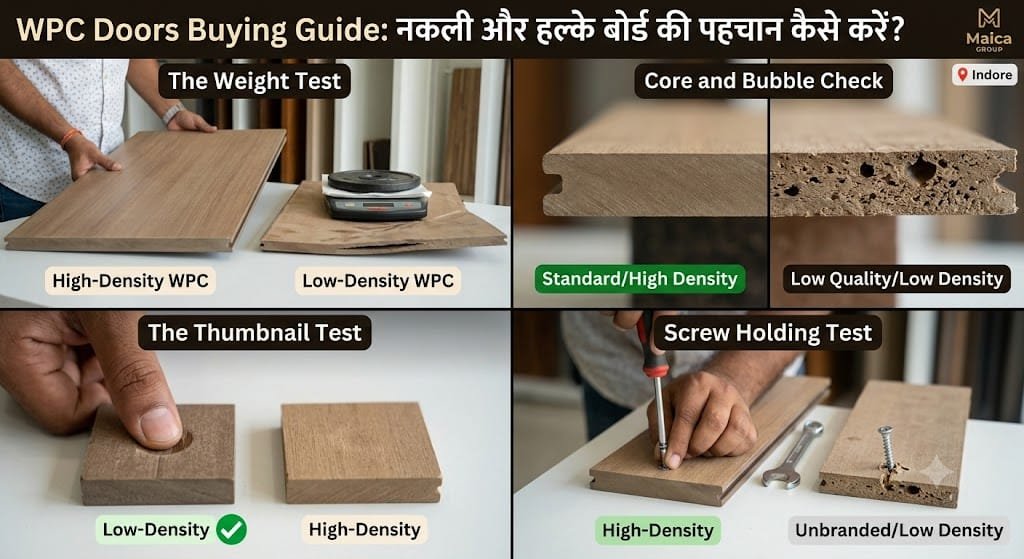
Instead of relying solely on the seller’s claims, perform these 5 simple tests right at the store:
- The Weight Test: Lift doors or boards from two different brands. A premium, high-density door will feel significantly heavy. If a large board feels as light as thermocol, it is low-density.
- The Thumbnail Test: Press your thumb’s nail with full force into an unfinished corner of the board. If it leaves a deep indentation easily, the material is low-density. A premium high-density board will feel as hard as rock.
- The Core and Bubble Check: Inspect the cut edge of the board. If you see large air bubbles, gaps, or a crumbly texture, the board is weak. A premium board features a solid, uniform, and fine-grained core.
- The Screw Holding Test: Ask your carpenter to drive a screw into a small sample piece. If the screw keeps spinning without tightening, the core is hollow. High-density WPC grips screws just like solid hardwood.
- The Surface Smoothness Test: Run your hand over the board’s surface. High-quality WPC boards have a perfectly flat and wave-free surface. Waves or unevenness indicate sub-par machinery and low-grade raw materials.
Key Advantages of Premium WPC Doors
- 100% Termite Proof: The PVC content ensures that termites, borers, and pests can never damage your doors.
- 100% Waterproof: It does not swell, rot, or split when exposed to moisture—making it the ultimate choice for bathrooms and kitchens.
- Fire Retardant: It does not ignite easily and acts as a self-extinguishing material during fire hazards.
- Eco-Friendly: No trees are cut down to manufacture WPC, and the boards are 100% recyclable.
Conclusion: Why Maica Group is Your Safest Bet
Do not jeopardize your home’s safety and aesthetics to save a few bucks on cheap, unbranded boards. The easiest way to avoid fake, low-density materials is to buy from a certified and trusted manufacturer.
For 100% authentic, high-density products, trust Maica Group. Our WPC doors, frames (Chaukhat), and PVC sheets are manufactured using state-of-the-art German technology and under strict quality controls. With our products, you get unmatched screw-holding capacity and lifetime durability.
Want to make the right choice for your home? Visit our WPC door manufacturing unit in Indore today