
The Eco-Friendly Shift: How the Architecture & Interior Business is Going Green
Here is a deeper look into how WPC, PVC, and CNC technologies are driving this eco-friendly paradigm shift. This isn’t just a temporary trend—it is a complete realignment of how businesses source, manufacture, and design products.
The global building and interior market is undergoing a massive transformation. Driven by stricter environmental regulations (such as the EU’s carbon reduction mandates), tightening deforestation policies, and growing consumer demand for sustainable living, businesses are shifting away from traditional resources. The global Wood-Plastic Composite (WPC) market alone is skyrocketing, projected to leap from $7.32 billion in 2024 to nearly $20 billion by 2034.
1. WPC (Wood Plastic Composite): Fighting Deforestation Through the Circular Economy
Traditional luxury interiors have historically relied heavily on hardwood timber. However, the environmental cost of harvesting raw wood has forced a major shift toward composite technology.
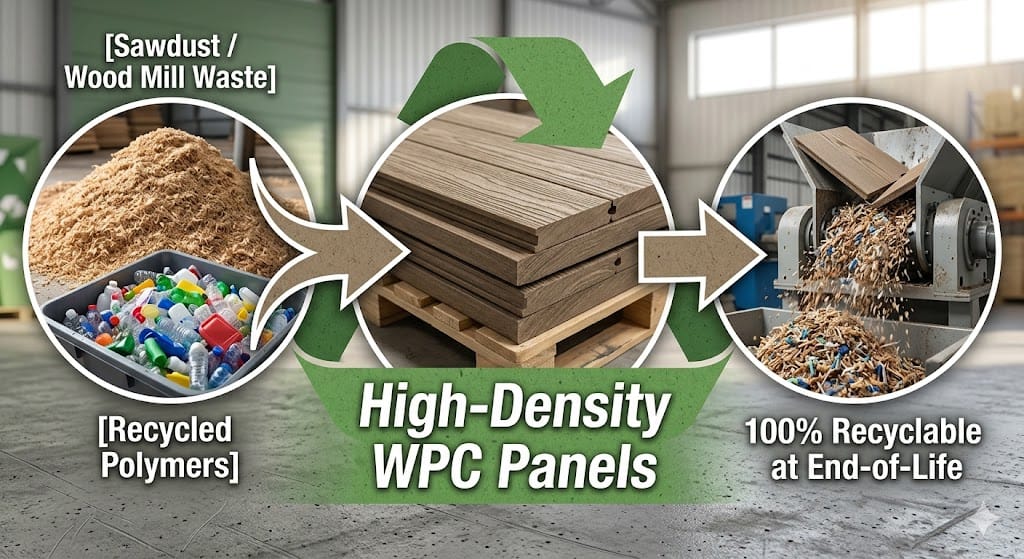
- No Fresh Timber Required: WPC completely preserves natural forests by utilizing up to 70% industrial biomass material (like sawdust, wood shavings, and agricultural waste) mixed with recycled plastic granules.
- Elimination of Chemical Pollution: Unlike natural wood, which requires regular applications of toxic chemical sealants, anti-termite poisons, and formaldehyde-heavy varnishes, WPC is completely immune to rot, water, and pests out of the box. This keeps volatile organic compounds (VOCs) out of the ecosystem and indoor air.
- Closed-Loop Lifespan: High-quality WPC boards are 100% recyclable. When an interior is remodeled, old panels can be cleanly reground and re-extruded into brand-new composite materials, minimizing landfill load.
2. Engineered PVC: Longevity as a Sustainability Strategy
While the manufacturing of virgin plastics has a high environmental footprint, the design industry’s approach to Polyvinyl Chloride (PVC) has evolved to focus on the circular loop and product longevity.
- The Power of Extended Life Cycles: One of the core tenets of green building is reducing consumption over time. High-density PVC sheets and charcoal panels can easily last 20 to 25 years without warping, cracking, or losing structural integrity in high-moisture environments.
- Industrial Scrap Reclamation: Modern sustainable PVC manufacturing relies heavily on industrial recycling. Up to 100% of factory cutting scrap can be instantly melted down and reused, allowing green factories to operate near zero-waste targets.
3. CNC Automation: Eradicating Resource Waste via Precision Engineering
The shift to eco-friendly business practices also covers the manufacturing process itself. Traditional carpentry and hand-carving methods are notorious for producing vast amounts of unrecoverable, irregular material waste due to human error.
- Optimized Material Nesting: Computer Numerical Control (CNC) machinery utilizes advanced AI algorithms to arrange pattern cutouts on a board with mathematical precision. By nesting designs tightly together, the machine extracts maximum product yields from every single panel, bringing raw material waste down to an absolute minimum.
- Energy Efficiency: Modern automated CNC machinery operates on high-speed optimization lines, minimizing the total energy and carbon footprint required per manufacturing run compared to slow, traditional processing methods.
The Green Matrix: Why Modern Businesses Are Choosing WPC Products
| Traditional Building Materials | The Eco-Friendly Upgrade (WPC/PVC/CNC) | Environmental Business Impact |
| Virgin Hardwood & Plywood | Recycled Wood Fiber + Plastic Polymer | Drastically reduces deforestation rates. |
| Toxic Chemical Varnishes & Stains | Factory-Finished, UV-Resistant Surfaces | Eliminates harmful VOC chemical runoff. |
| Frequent Replacement/Rot/Warping | Waterproof & Termite-Proof Durability | Lowers lifetime material consumption by 50%. |
| High Production Scrap & Waste | Precision CNC Sheet Nesting & Sorting | Achieves close to zero-waste manufacturing goals. |
Build beautifully without the environmental guilt. Contact us to explore our premium collection of eco-friendly, durable doors and sustainable frames.